How to boost breast milk supply naturally
What actually raises milk supply, how to tell whether yours is genuinely low, and where to find a lactation consultant in Singapore.

Milk supply answers to one thing above all others, which is how often and how completely milk is removed. Feed or pump more frequently, check the latch, and the supply follows. The AAP puts newborn feeds at roughly 8 to 12 times in 24 hours, and most worries about low supply turn out to be a latch problem or a normal baby.
Before changing anything, it is worth finding out whether your supply is actually low. Most of the time it is not.
Is your supply genuinely low?
The unreliable signs first, because these are what send mothers to the pharmacy at 11pm.
- Soft breasts that no longer feel full. Normal from around six weeks, when supply settles to demand.
- A baby who wants to feed again an hour later. Normal, and breast milk digests fast.
- No leaking. Normal.
- A small amount when you pump. Pumps measure how a body responds to a pump, which for many women is poorly.
- A baby who feeds for forty minutes, or for seven.
What actually tells you, according to the NHS:
- Heavy wet diapers several times a day once you are past the first week
- Soft, regular stools
- Steady weight gain along her own curve on the growth chart in your health booklet
- A baby who comes off the breast settled, at least some of the time
Your polyclinic will weigh her and plot it. That single number ends more sleepless speculation than anything else available.
The one mechanism that matters
Breasts make milk in response to milk leaving. Milk left in the breast signals the body to make less, and a thoroughly drained breast signals it to make more. Everything that follows is a way of acting on that.
So the levers are frequency, completeness and latch. Supplements are not on the list. Nobody wants to hear that.
Feed more often, and let her finish
Feed on demand rather than by the clock, and that includes at night, when the hormone that drives milk production runs highest.
Offer the second breast after the first is soft. Switch sides more than once if she is sleepy and keeps dozing off. Compress the breast gently while she feeds to keep the flow going when her sucking slows.
Skin contact between feeds helps too, as does keeping her close rather than in a cot across the room. Our notes on when breast milk comes in cover the first few days, which are their own separate ordeal.
Fix the latch before anything else

A shallow latch takes milk out badly, which lowers supply and hurts at the same time. La Leche League's positioning guidance is the standard reference, and the checks are simple. Her mouth should be wide, her chin against the breast, more of the lower part of the areola in her mouth than the upper, and nothing should pinch.
Pain beyond the first few seconds means the latch is wrong. Cracked or bleeding nipples mean it has been wrong for a while. The fix is the latch, and a crack that is not settling, or looks red and angry, is one for your doctor.
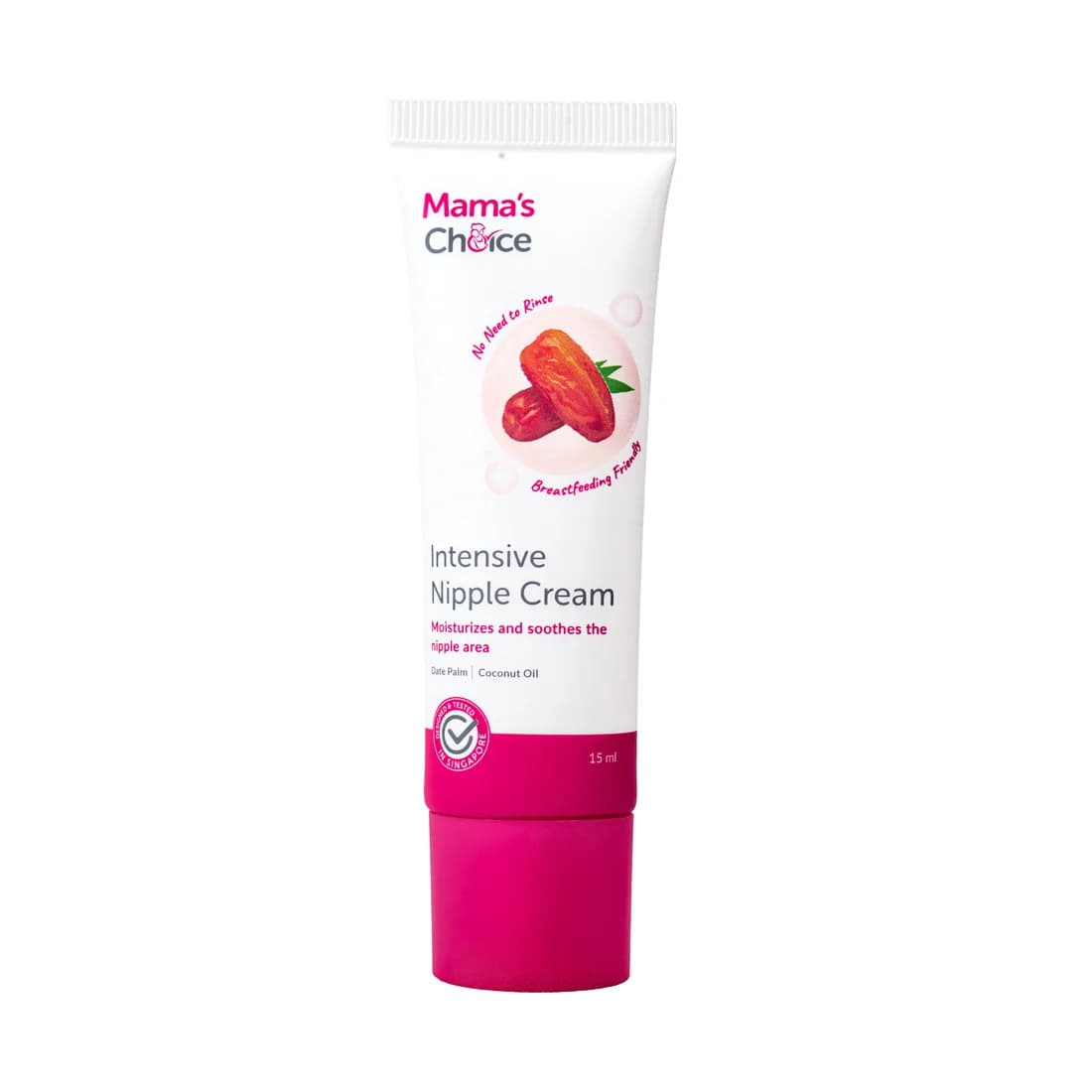
For everyday dryness, our Intensive Nipple Cream is a lanolin-based cream that moisturises and protects nipple and areola skin. No cream changes the latch.
Get the latch watched by someone who knows. KKH and NUH both run lactation services, polyclinics have nurses trained in breastfeeding support, and the Breastfeeding Mothers' Support Group runs a peer helpline and support sessions. One session usually settles it. Book it early. More on the pain itself is in breastfeeding pain remedies.
Pumping to add removals, not to measure
If she is feeding well and you still want to build supply, add pump sessions between feeds rather than replacing feeds. Pumping both sides after a morning feed is the slot many mothers find easiest, because supply is usually highest then.
Hand expression after pumping gets out what a pump leaves behind. It feels primitive. It works.
Blocked ducts turn up when a breast is not emptying evenly, and in our humidity a hot, tender lump escalates quickly. Clearing a clogged duct covers what to do that evening.
Do milk boosters work?

Fenugreek, moringa, green papaya soup, fish soup, oats, brewer's yeast, lactation cookies and the red date tea your mother-in-law has already bought. A Cochrane review of oral galactagogues concluded the evidence was too uncertain and too inconsistent to recommend any of them.
That is not a reason to refuse your confinement food. A bowl of fish soup is nourishing, warm and prepared by someone else, and each of those helps a mother who is barely eating. The problem is only when a supplement replaces the thing that works. Our page on fenugreek as a milk booster looks at the specific claims, and foods worth eating while breastfeeding covers what to eat for your own sake.
Prescription medicines to raise supply exist and belong with a doctor who knows your history. They are not something to source from a friend's leftover box.
Looking after yourself
Supply suffers when you are running empty. Eat at the times food appears, drink to thirst in a climate that dehydrates you quietly, and sleep when the baby does even if the flat is a mess.
Stress and pain both interfere with the let-down reflex. A warm shower, a few minutes alone, a hand on the baby's skin, and feeding somewhere that is not the living room with the television on will each do more than they sound like they should.
Confinement rules that leave you hungry, hot or unable to drink cold water are worth renegotiating. Our guidance there is to keep the help and drop the restrictions that make you miserable.
Returning to work at four months
Government-Paid Maternity Leave in Singapore runs for 16 weeks for eligible mothers, which puts many mothers back at a desk at around four months, exactly when supply is settled and vulnerable to a long day without removal.
Plan the pumping schedule before the first day back, not during it. Aim to pump at roughly the hours she would have fed, build a modest freezer store in the final weeks of leave, and find out where the nursing room is on your floor. Our guide to pumping at work covers the logistics, including storage in an office fridge and transport home in this heat.
If supply dips in the first fortnight back, the answer is usually an extra removal rather than a supplement. Add one session, give it a few days, and watch the diapers rather than the bottle volume.
Frequently asked questions
- How do I know whether my supply is really low?
- Count output, not feelings. The NHS points to heavy wet diapers several times a day from the end of the first week, soft stools, and steady weight gain along her growth curve. Soft breasts and a baby who feeds often are both normal and prove nothing.
- Do milk boosters work?
- A Cochrane review of oral galactagogues found the evidence too uncertain to recommend any of them. Fenugreek, moringa, papaya soup and lactation cookies may do no harm, and none of them substitutes for milk being removed more often.
- How often should a newborn feed?
- The AAP puts it at roughly 8 to 12 times in 24 hours in the early weeks, including at night. Feeding on demand rather than on a schedule is what sets supply in the first month.
- Will my supply drop when I go back to work?
- It can, if milk is not removed during the day. Government-Paid Maternity Leave runs for 16 weeks for eligible mothers, so many women here face this at around four months. Pumping at roughly the times your baby would have fed is what holds supply steady.
- Should I avoid cold drinks during confinement?
- There is no evidence that cold drinks reduce milk supply. Drink to thirst, whatever temperature you like. Dehydration is the real risk in our climate, and iced water is the thing many mothers will actually finish.
Sources
- WHO — Infant and young child feeding, exclusive breastfeeding for six months
- AAP HealthyChildren — How often and how much should your baby eat
- La Leche League International — Milk supply and increasing it
- Cochrane — Oral galactagogues for increasing breast milk production in mothers of non-hospitalised term infants
- NHS — Breastfeeding, is my baby getting enough milk
- KK Women's and Children's Hospital — Lactation support services
- National University Hospital — Breastfeeding and lactation clinic
Share this article
This article is for information only and is not a substitute for diagnosis or medical advice. Please talk to your doctor about your own situation.