Breastfeeding tips for new Mamas in Singapore
Latching, sore nipples, engorgement and the return to work at 16 weeks, with the lactation help you can actually book in Singapore.

Nobody gets a perfect latch on the first try. The tips worth keeping are the ones that tell you what to do at 3am on day four.
Breastfeeding goes better when you feed early and often, fix the latch before you reach for nipple cream, and get skilled help within days rather than weeks. In Singapore that help sits at KK Women’s and Children’s Hospital, the National University Hospital and your polyclinic, and most of it can be booked.
How do you get breastfeeding off to a good start?
The first hour matters more than the first week.
The World Health Organization recommends early and uninterrupted skin-to-skin contact after birth, ideally within the first hour, because it settles the baby and gets the first feed going while both of you are still alert. KKH and NUH both run antenatal classes with lactation input, and booking one in the third trimester costs you an afternoon. Ask who you will see on the ward. Ask what happens if the latch does not work.
Rooming in helps for the same reason. A baby beside you feeds on cue instead of on a trolley schedule, and the frequent stimulation of those early days is what tells your body how much milk to make.
What should you do about sore and cracked nipples?
Look for the cause before the symptom. Most nipple pain in the first fortnight comes from how the baby is attached, and the NHS puts checking positioning and attachment ahead of everything else, because cream over a poor latch buys you a few hours at most.
Pain that lasts through the whole feed, a nipple that comes out flattened or wedge-shaped, clicking sounds, and a baby who keeps sliding off are all signs the attachment needs work. Change position and try again. Hand express a little first so the breast is softer and the areola easier to take.
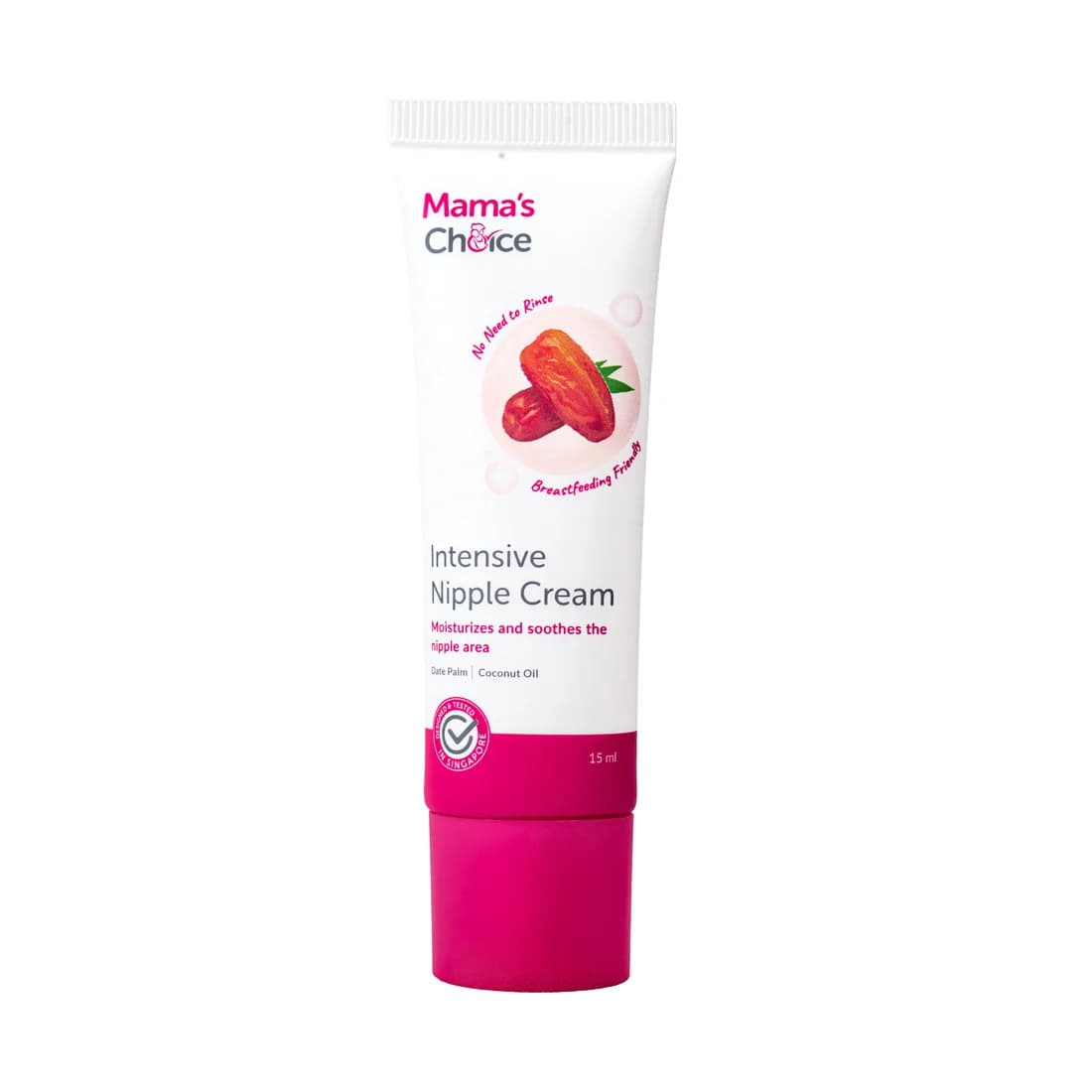
Once the latch is sorted, the skin usually settles over the following days, and keeping it moisturised between feeds makes those days more comfortable. Our Intensive Nipple Cream is a rich lanolin balm with shea butter, coconut oil and date extract that moisturises and protects nipple and areola skin. In a 2022 satisfaction survey of 74 mothers, 96% felt dry nipple skin became softer. A bean-sized dab after each feed is enough, and a tube goes a long way. If the skin is open or weeping, ask your polyclinic, GP or lactation consultant to look at it. Our guide to breastfeeding pain remedies goes through what each kind of pain usually means.
A streak of your blood in your baby's spit-up from a cracked nipple looks alarming but is usually harmless to your baby. Mention it at the next check if you are unsure. Deep or burning pain between feeds is a different problem and worth a review.
How often should a newborn feed, and do you watch the clock?
Watch the baby. The American Academy of Pediatrics, writing on HealthyChildren.org, puts newborn feeding at roughly eight to twelve feeds in twenty-four hours, driven by cues rather than by a timer, which in practice means a feed every couple of hours with one longer stretch if you are lucky.
Early hunger cues are quiet. Stirring, turning the head, hands going to the mouth, licking the lips. Crying is the late one, and a baby who has been crying hard often needs calming before they can attach at all.
Wet diapers are your evidence. The NHS describes six or more heavy wet diapers a day from the end of the first week, along with pale urine and steady weight gain in the health booklet, as the practical sign that enough milk is going in.
What helps when your breasts feel engorged?
Engorgement tends to peak in the first week, and it can feel like a fever in your chest.
Cochrane's review of treatments for breast engorgement during lactation looked at cabbage leaves, cold packs, gels and ultrasound, and concluded that the evidence was too weak to recommend any single one. Feeding is what empties a breast. Short frequent feeds on the fuller side, a warm shower beforehand, something cold afterwards for comfort, and hand expression to soften the areola enough for your baby to attach.
A hard lump that stays in the same place after a feed needs attention sooner. Our guide to clearing a clogged milk duct covers what to try at home and when to get help. A red, painful wedge on the breast with fever and body aches is likely to be mastitis, and that is a same-day visit to a polyclinic or your obstetrician.
Does what you eat change how much milk you make?
Supply answers demand. Milk removal is what drives milk production, so frequent feeding and expression raise supply while lactation cookies mostly raise your sugar intake.
Eat enough and drink to thirst. In this climate that is more water than you expect, particularly if you walk to the hawker centre at noon and then feed all evening in an air-conditioned bedroom. HealthHub's advice for a breastfeeding mother is a balanced diet and enough fluids, with no single food named as the answer for supply.
No single food has solid evidence that it increases milk supply. Oats are ordinary food and fine to enjoy. Fenugreek is a herb rather than a food at supplement doses, and it can upset the stomach and lower blood sugar, so check with your doctor first, especially if you have diabetes, take blood thinners or are allergic to peanuts or chickpeas. If supply genuinely worries you, count diapers and check the weight before you change your groceries. How to boost breast milk supply naturally sets out what actually moves the number.
When does pumping at work start?
Government-Paid Maternity Leave entitles eligible working mothers in Singapore to 16 weeks under the scheme the Ministry of Manpower administers, so the first pump at the office usually lands somewhere around your baby's fourth month. Start practising a fortnight before you return, rather than the night before.
Find out where you will pump and tell your manager before your first morning back. Plenty of offices here have a nursing room, and those that do not can usually free up a meeting room with a lock on it. Keep a cooler bag at your desk. Pumping at work has the scheduling and the storage detail.
Who can you call in Singapore when feeding is going badly?
Lactation consultants practise at KK Women's and Children's Hospital and the National University Hospital, and both see mothers who delivered elsewhere. Polyclinics run the postnatal review and the baby's weight checks, and they refer onward when feeding is the problem. HealthHub, published by the Health Promotion Board, holds the national breastfeeding and postnatal pages, including milk storage guidance worth printing for the fridge door.
Peer support matters too. La Leche League International runs volunteer leaders and local groups in many countries, and its meetings cost nothing.
If you have booked a confinement nanny, agree the feeding plan before she arrives. A nanny who quietly tops up with formula overnight while you sleep is being kind and lowering your supply at the same time, so say plainly whether you want to be woken for every feed.
Write that plan on the fridge. Your nanny, your mother and your partner all read the same version, nobody has to wake you to ask what you wanted, and the awkward conversation happens once instead of every night.
Frequently asked questions
- How soon should I ask for help if feeding hurts?
- Within days. Pain that lasts through a whole feed usually means the attachment needs adjusting, and someone watching you feed will spot in minutes what you cannot see from above. Lactation consultants at KK Women’s and Children’s Hospital and the National University Hospital see mothers who delivered elsewhere, and your polyclinic can refer you.
- Do cabbage leaves help with engorgement?
- Cochrane reviewed treatments for breast engorgement during lactation, cabbage leaves among them, and found the evidence too weak to recommend any one of them. The approach with the most logic behind it is a feed, since removing milk is what softens a breast. Cold afterwards is for comfort.
- When do I need to start pumping before going back to work?
- Around a fortnight before your first day back, which for most mothers falls near the end of 16 weeks of Government-Paid Maternity Leave. Practising early gives you time to build a small freezer stash and to find out how your body responds to a pump, which is rarely the same as how it responds to your baby.
- Can I breastfeed if my supply feels low in the first week?
- Usually yes, and the first week is when supply is still being set rather than measured. Count heavy wet diapers and watch the weight in your health booklet instead of guessing from how soft your breasts feel. If weight gain stalls, get the feeding assessed before deciding on top-ups, and if your doctor suggests formula for a while, follow it without guilt.
Sources
- World Health Organization — Early initiation of breastfeeding and skin-to-skin contact
- NHS — Breastfeeding: positioning, attachment and sore nipples
- AAP, HealthyChildren.org — How often and how much should your baby eat
- Cochrane — Treatments for breast engorgement during lactation
- HealthHub (Health Promotion Board) — Breastfeeding and postnatal care
- Ministry of Manpower — Government-Paid Maternity Leave scheme
- KK Women’s and Children’s Hospital — Antenatal classes and lactation services
- La Leche League International — Mother-to-mother breastfeeding support
Share this article
This article is for information only and is not a substitute for diagnosis or medical advice. Please talk to your doctor about your own situation.