Is fluoride in toothpaste safe for children?
Fluoride protects teeth against decay, and the real question is dose. Age-by-age toothpaste amounts, what fluorosis is, and when a fluoride-free paste makes sense.

Mama’s Choice makes a fluoride-free toothpaste, so the fair place to begin is with what fluoride does well.
Fluoride protects teeth against decay, and that benefit is not seriously disputed by any major health body. The real question for a young child is dose. Use a rice-grain smear under 3 and a pea-sized amount from 3 to 6, hold the brush yourself, and teach spitting rather than swallowing.
What does fluoride actually do to a tooth?
Fluoride is a mineral, and it works on the surface of the enamel. It makes enamel harder for acid to dissolve, and it helps the enamel take back minerals that early decay has already stripped out. The work happens in the mouth, during the couple of minutes the paste sits on the teeth.
The World Health Organization regards fluoride as one of the most effective ways to reduce dental caries across a population. The NHS puts fluoride toothpaste twice a day at the base of children’s dental care. The American Academy of Pediatrics, writing on HealthyChildren.org, recommends starting fluoride toothpaste as soon as the first tooth shows.
Those bodies have read the same literature the worried posts quote. Something has to explain the gap.
Where do the fluoride worries come from?
Almost all of them trace back to fluoride that is swallowed, in quantity, over years. The usual source in that research is drinking water in regions where fluoride occurs naturally at high concentrations, which is a different exposure from brushing and spitting out.
Headlines about fluoride and children’s brain development come from that body of work rather than from studies of toothpaste. The World Health Organization keeps a guideline value for fluoride in drinking water for exactly this reason, because the amount is what decides whether fluoride protects or harms. A smear of paste, brushed and spat out, sits a long way below it.
Eating a whole tube is a separate matter, and it does make a child ill. Keep the tube out of reach.
What is dental fluorosis, and how likely is it?
Fluorosis is a change in the look of enamel. It happens when a child takes in too much fluoride while the permanent teeth are still forming under the gums, so the window closes somewhere around 8 years old.
In the mild form, which is the form you might actually see, it shows as faint white flecks or fine lines across the enamel. The US Centers for Disease Control and Prevention describes mild fluorosis as a cosmetic condition with no effect on how the tooth works. Severe fluorosis, the kind with brown staining and pitted enamel, comes from intakes far above anything a child in Singapore is likely to meet.
It is not pain or decay. The avoidable source in a toddler is swallowed toothpaste, which is the whole reason the amounts below are so small.
How much toothpaste should a child use?
| Age | How much paste | Who holds the brush |
|---|---|---|
| First tooth to 3 years | A smear the size of a grain of rice | You do, twice a day |
| 3 to 6 years | A blob the size of a pea | Your child starts, you finish |
| 6 years and older | Pea-sized, with proper spitting | Supervise, then spot-check |
The American Academy of Pediatrics and the NHS both give these amounts, and both ask for adult supervision until a child can be trusted to spit the foam out instead of swallowing it. The NHS adds a step most of us skip at the basin. Spit, and do not rinse with water afterwards, because rinsing washes away the fluoride that was about to do its work.
A brush loaded from end to end, the way the adverts show it, is several times what a toddler needs.
When is a fluoride-free toothpaste a reasonable choice?
The strongest reason is a child who cannot spit yet and swallows most of what goes in. Under 3 that is ordinary behaviour. With a fluoride-free paste there is no swallowed dose to ration, which takes one calculation out of a difficult two minutes.
A fluoride-free children's paste in a rice-grain smear is one option for that stretch, and Mama's Choice makes one, the Baby & Kids Toothpaste, for children from 6 months. A fluoride paste in a rice-grain smear, with you holding the brush, is what the AAP, the NHS and HealthHub recommend, and it is the choice with the stronger evidence against decay. With a fluoride-free paste, regular brushing may help fight tooth decay, but it does not give the protection fluoride does.
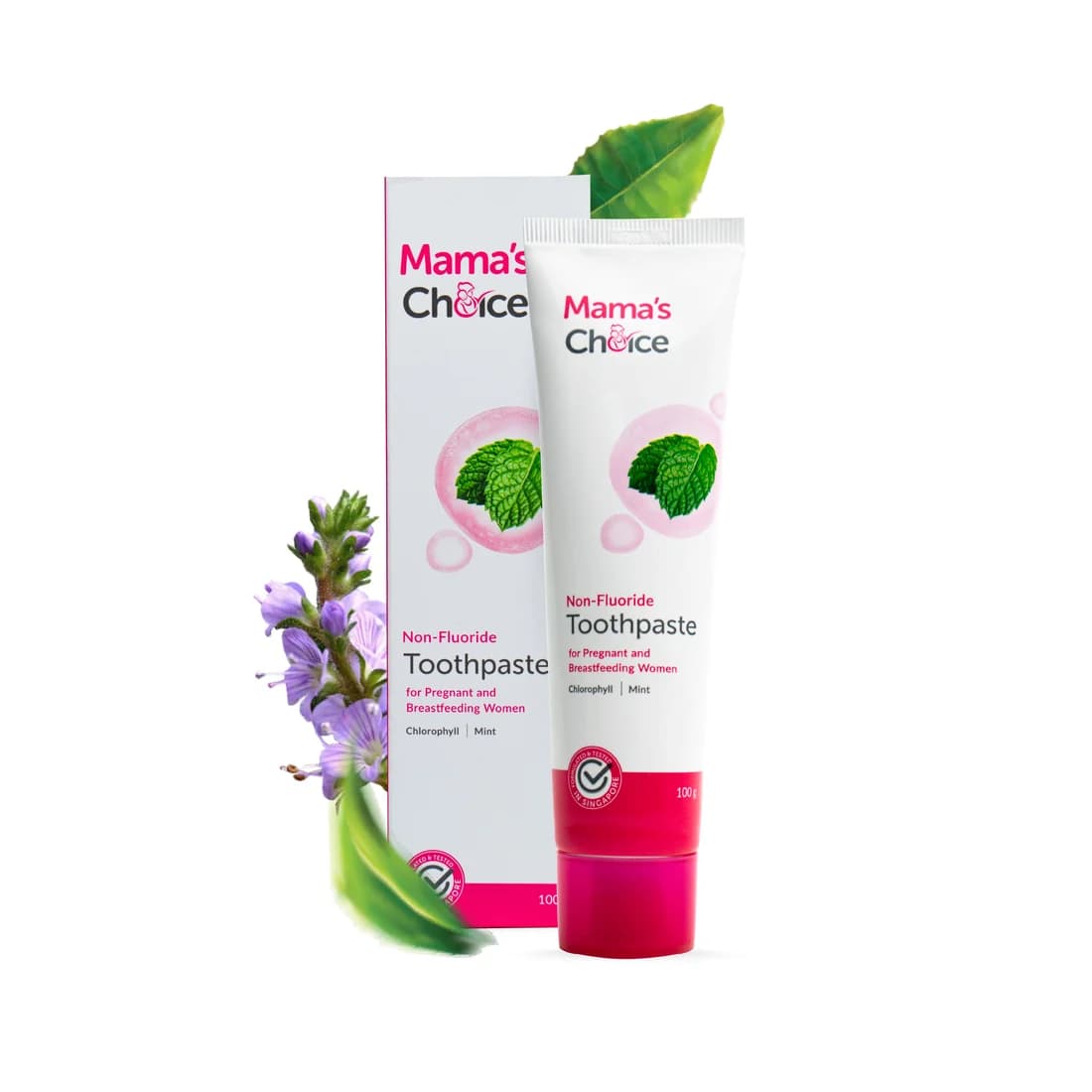
Our Non-Fluoride Toothpaste is the adult paste we made for pregnancy, for mothers whose gag reflex turns a strong minty paste into a fight in the first trimester. It is SLS-free with a light mint taste, and in a 2022 satisfaction survey of 62 mothers, 93% said they felt comfortable using it, with no nausea. Brushing with something you can tolerate beats skipping the brush.
A child who already has cavities, or who keeps getting them, needs what fluoride gives, and a dentist will usually ask for more fluoride rather than less. Once your child spits reliably, the main reason to skip it has gone.
What does Singapore advise?
HealthHub, the Health Promotion Board’s consumer health site, backs fluoride toothpaste for children with the same age-based amounts, and the Health Promotion Board runs the School Dental Service, which checks and cares for children's teeth through schools, with screening reaching preschools as well. Tap water here carries fluoride too, so your child picks up a little from drinking water alongside the brush.
That is an argument for measuring the paste, not for throwing the tube away. If you are weighing it up while expecting, our note on choosing a toothpaste in pregnancy goes through the ingredient list, and toothaches during pregnancy covers the dental questions that arrive with a sore tooth. The American College of Obstetricians and Gynecologists regards brushing with fluoride toothpaste as routine care while pregnant.
What matters more than the tube you choose?
How often sugar reaches the teeth matters more than how much arrives at once. A sweet drink sipped across a whole afternoon does more damage than the same drink finished in ten minutes, because the enamel never gets a break from the acid.
Brush twice a day, and make the bedtime brush the one that never gets skipped. Saliva flow drops overnight, which leaves anything still on the enamel sitting there for hours. Swollen gums in a small child are worth a look rather than a wait, and so is any chalky white or brown mark near the gum line.
Start cleaning between the teeth once the back molars meet, because no brush reaches a contact point. Floss sticks are far easier than string with a wriggling child. Guardian and Watsons both stock them cheaply.
Keep the paste somewhere your toddler cannot climb to. Children who like the flavour will help themselves, and that is the one scenario where quantity genuinely becomes a problem.
Frequently asked questions
- Is fluoride toothpaste dangerous for a baby?
- No, when the amount is right. The American Academy of Pediatrics recommends fluoride toothpaste from the first tooth, using a smear the size of a grain of rice until age 3. The risk people worry about comes from swallowing paste day after day, which is why the smear is so small and why an adult holds the brush.
- What is dental fluorosis, and will my child get it?
- Fluorosis is a change in how enamel looks, caused by taking in too much fluoride while the permanent teeth are still forming. The US Centers for Disease Control and Prevention regards the mild form, faint white flecks, as cosmetic rather than a disease. Measuring the paste keeps the main avoidable source under control.
- Can I use fluoride toothpaste while pregnant?
- Yes. The American College of Obstetricians and Gynecologists regards brushing with fluoride toothpaste as ordinary care during pregnancy and encourages dental check-ups. If a strong minty paste sets off nausea, a milder formula you will actually use twice a day is better than skipping the brush.
- Is Singapore tap water fluoridated?
- Yes, the public water supply here carries fluoride, which is one reason to stick to the stated amount of paste rather than squeezing a ribbon across the bristles. HealthHub, the Health Promotion Board’s consumer site, still recommends fluoride toothpaste alongside it for children.
Sources
- AAP, HealthyChildren.org — Brushing up on oral health: fluoride and toothpaste amounts for children
- NHS — Children's teeth: brushing and fluoride toothpaste
- US Centers for Disease Control and Prevention — Dental fluorosis
- World Health Organization — Fluoride in drinking water and oral health
- HealthHub (Health Promotion Board) — Caring for your child's teeth
- Health Promotion Board — School Dental Service
- ACOG — Oral health care during pregnancy and through the lifespan
Share this article
This article is for information only and is not a substitute for diagnosis or medical advice. Please talk to your doctor about your own situation.