
Baby carrier safety tips for Singapore parents
Airway, tightness and hip position decide whether a carrier is safe. Plus what Singapore heat, MRT crowds and haze season do to babywearing.
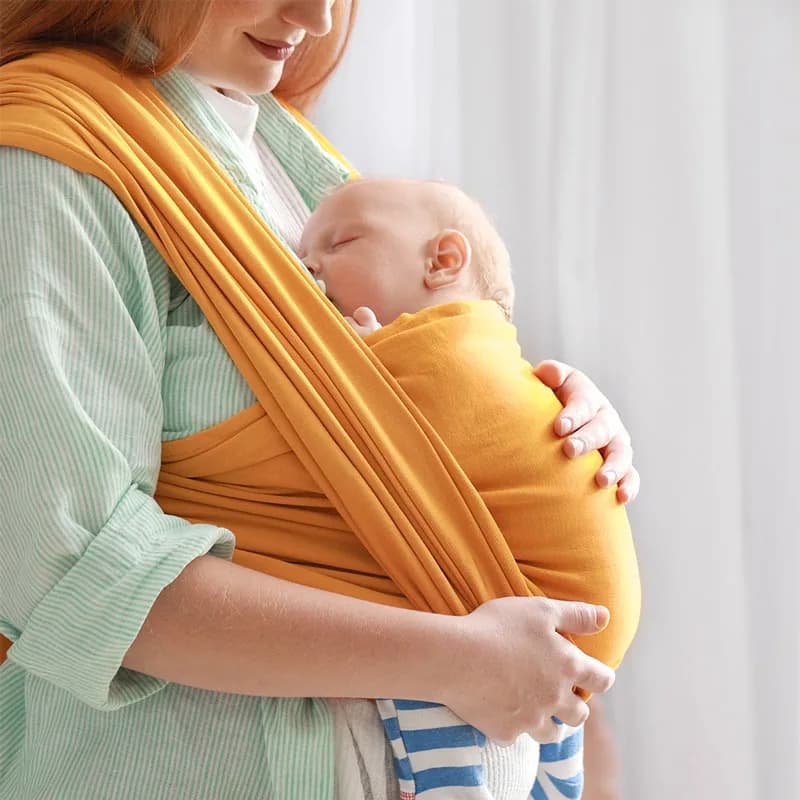
A carrier is safe when your baby's face is visible, the chin is off the chest, the fabric is tight against your body, and the thighs are supported with the knees above the bottom. In Singapore the fourth consideration is heat, so plan your route around shade and air-conditioning.
What actually goes wrong with carriers?
Two things, and neither of them is the carrier falling apart.
The first is the airway. According to the American Academy of Pediatrics, whose HealthyChildren guidance covers carriers and slings, a young baby whose chin is pressed onto the chest can restrict its own airway, and a baby whose face is buried in fabric or in your body can suffocate silently. Newborns have no neck strength to lift themselves out of that position.
The second is position over time. The same guidance describes supporting the thighs so the legs spread around the wearer, rather than dangling from the crotch, which is also the advice given to families whose babies are being followed for developmental dysplasia of the hip.
Everything below comes back to those two points.
Is your baby's face clear?
Check it every time you tighten a strap, and check it again when your baby falls asleep.
You want the face turned to one side and visible, not pressed into you. One finger's width between chin and chest. Nose and mouth uncovered by fabric, hood or your own clothing.
A sleeping newborn slumps. That is when the chin drops, so a sleeping baby needs a look rather than a smile.
Is the carrier tight enough?
Tug every strap before your baby goes in. Adjustable buckles are awkward to reach once there is a baby in the way, and fiddling with them one-handed is how babies slip.
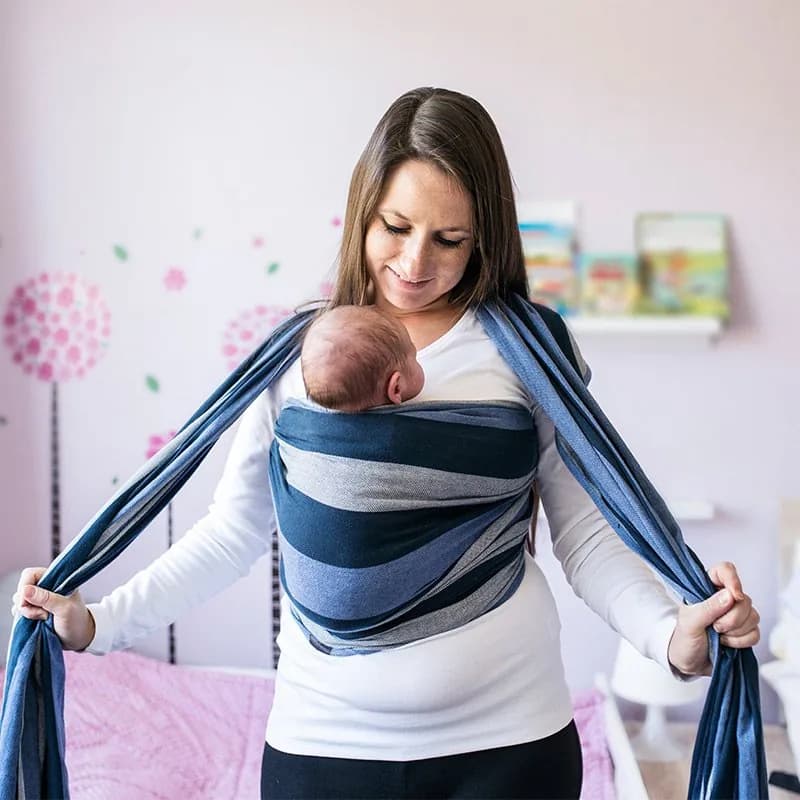
A correctly tight carrier holds your baby against you with no gap to slump into. You should be able to kiss the top of the head without leaning far forward. Loose fabric lets your baby sag into a C shape, which pushes the chin down and makes the airway problem worse.
Your back benefits too. A carrier worn low and loose transfers the weight to your lumbar spine, which is a miserable way to walk through Orchard Road. If you are already dealing with that, our guide to back pain in pregnancy covers the same mechanics.
Are the hips supported?
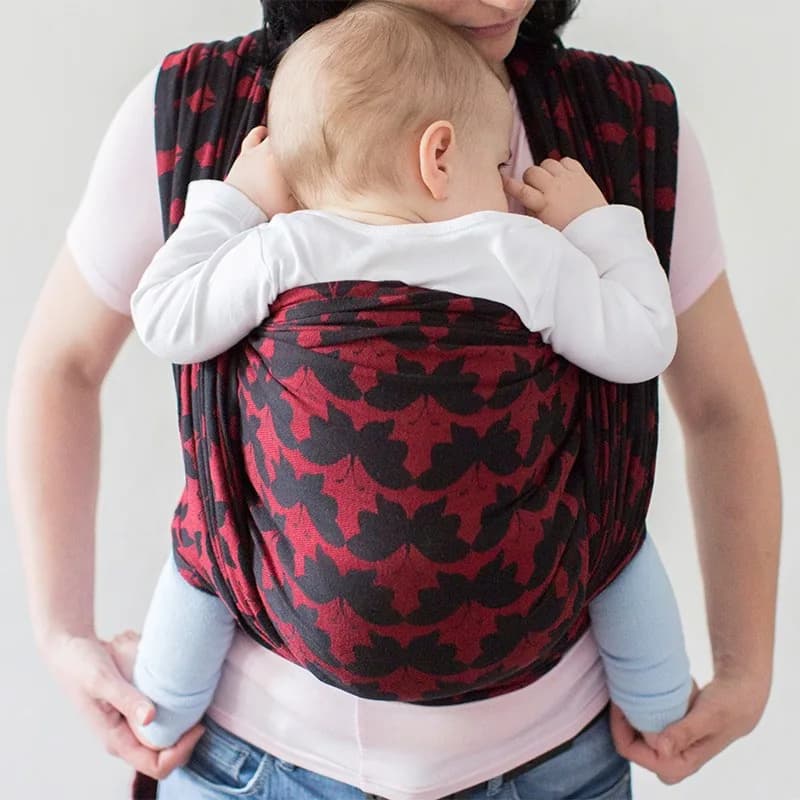
Knees higher than the bottom, thighs supported to the knee, legs spread around your torso. The shape people describe as an M.
A narrow seat panel leaves the legs hanging straight down with all the weight through the crotch. The American Academy of Pediatrics advises against that position for young infants. If your baby is under surveillance for hip dysplasia, or wore a harness as a newborn, ask the paediatrician at your polyclinic or at KK Women's and Children's Hospital which carriers they are happy with before you buy.
What does the Singapore climate do to babywearing?
It makes heat the thing you plan around.
A carrier presses your baby's chest and belly against yours, so your body heat has nowhere to go. Humidity here sits high through the year and sweat does not evaporate the way it does in a dry climate. HealthHub, the Ministry of Health's public portal, covers heat rash in babies, and a carrier panel is a classic place for it to appear.
What works in practice:
- One thin layer on your baby, and no extra blanket inside the carrier
- Mesh or cotton panels rather than thick padded fabric
- Check the back of the neck and the nape every twenty minutes or so, since that is where sweat shows first
- Plan the route through malls, MRT stations and covered walkways rather than open pavement at noon
- Take your baby out of the carrier when you sit down, so the skin gets air
Haze season changes the calculation again. On days when the PSI climbs, an infant strapped to your chest is breathing the same outdoor air you are, with a faster breathing rate and smaller airways. Keep the trip short or keep it indoors.
If a rash does appear, our piece on common baby rashes will help you tell heat rash from the others.
Where babywearing earns its keep here
On the MRT at rush hour, a carrier is easier than a stroller. Not every station has a lift near the exit you want, bus wheelchair ramps are often taken, and a stroller in a packed carriage is a struggle for everyone.
Wet markets and hawker centres are the other place it helps, since the aisles are too narrow for a stroller and the floors are wet. Keep your baby away from the stalls themselves. Hot soup, boiling kettles and wok oil are all at chest height.
Lift lobbies, void decks and covered walkways make most HDB errands doable in a carrier without ever standing in direct sun.
What to look for when buying one
| Feature | Why it matters in Singapore |
|---|---|
| Breathable mesh or cotton panel | Heat and humidity, every day of the year |
| Structured head and neck support | Keeps the chin off the chest in young babies |
| Wide seat panel to the knee | Supports the thighs and keeps the knees high |
| Stated weight range on the label | Tells you whether it suits a newborn or only a sitter |
| Buckles you can reach one-handed | You will be adjusting it while holding a baby |
| Washable fabric | Sweat, spit-up and sudden rain |
Secondhand carriers are common on local parenting groups. Check the webbing for fraying, the buckles for cracks and whether the instruction leaflet is still available, because a carrier with worn stitching is not a bargain.
For everything else you end up carrying, our diaper bag packing list is a useful cross-check, and newborn care essentials covers the rest of the kit.
When to take your baby out of the carrier
- Your baby's chin has dropped onto the chest, or the face is against fabric
- Breathing sounds noisy, fast or laboured
- The nape of the neck is damp and the skin is flushed
- You are about to cook, pour something hot, or get on a bicycle
- Your baby is fussing and arching, which can mean too hot as easily as hungry
- You feel strain in your lower back, since a tired wearer adjusts badly
The benefits of carrying are real, and our piece on the benefits of babywearing sets them out. They depend entirely on getting the position right, which takes a mirror and a few goes in the living room before you try it in a crowd.
Frequently asked questions
- What is the single biggest risk with a baby carrier?
- Airway obstruction in the first few months. The American Academy of Pediatrics, in its HealthyChildren guidance on carriers and slings, warns that a young baby curled with the chin on the chest, or with the face pressed into fabric or the wearer's body, can suffocate without making a sound. Face visible, chin off the chest, nose and mouth clear.
- Can a carrier cause hip dysplasia?
- Position matters. The American Academy of Pediatrics advises supporting the thighs so the knees sit higher than the bottom and the legs spread around the wearer, rather than hanging straight down from the crotch. A carrier that leaves the legs dangling puts the hip joint in a less favourable position, which is a concern for babies already being monitored for developmental dysplasia of the hip.
- Is it too hot to babywear in Singapore?
- It is manageable with planning. A carrier adds a second body's worth of heat against your baby's chest, and humidity here stays high all year, so heat rash and dehydration are the practical risks. Carry in air-conditioned places, go for breathable mesh panels, dress your baby in one thin layer, and check the back of the neck for sweat.
- What age can I start using a carrier?
- Most structured carriers list a minimum weight, commonly around 3.5 kg, and newborns need a carrier that holds the head and neck upright without an insert that crowds the face. Check the manufacturer's stated range and make sure your baby's head is supported, since neck control takes a few months to develop.
- Can I cook or drink coffee while babywearing?
- Avoid both. Hot liquid, splashing oil and open flames are all within reach of a baby strapped to your chest, and a wok at a hawker-style kitchen is no place for a carrier. Bend at the knees rather than the waist when picking things up, and keep one hand on your baby on escalators and stairs.
Sources
- American Academy of Pediatrics (HealthyChildren) — baby carriers, slings and backpacks safety guidance
- American Academy of Pediatrics (HealthyChildren) — developmental dysplasia of the hip
- NHS — baby sling and carrier safety
- HealthHub (Ministry of Health Singapore) — heat rash and caring for your baby's skin
Share this article
This article is for information only and is not a substitute for diagnosis or medical advice. Please talk to your doctor about your own situation.