
Is kiwi good for your hair?
What kiwi really contributes to hair, why no fruit stops shedding, when postpartum hair loss settles, and the cheaper local fruit that does the same job.
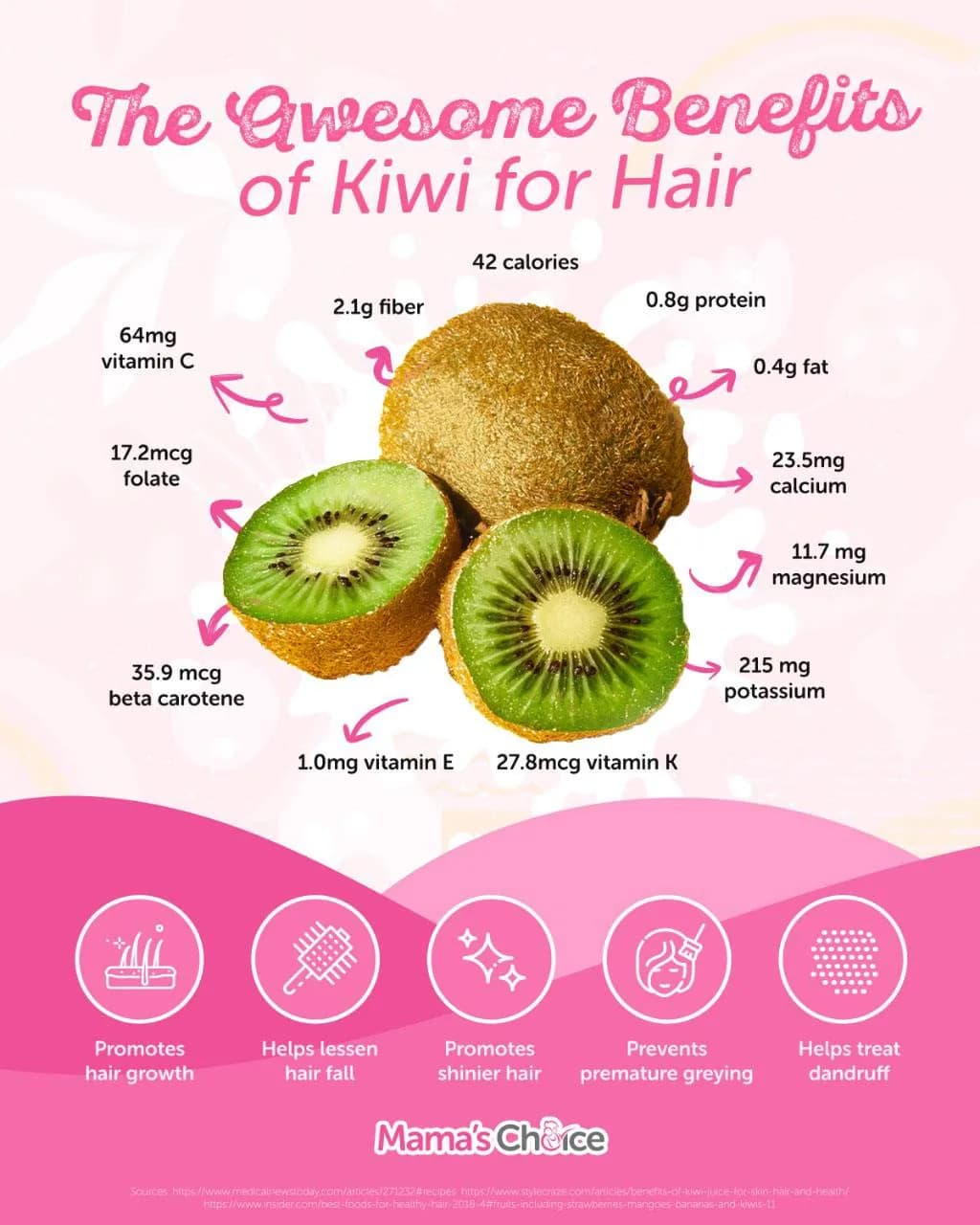
Kiwi is a useful source of vitamin C, which the body needs for collagen and which improves iron absorption from plant foods. Good nutrition supports normal hair growth. It does not add growth, stop postpartum shedding, prevent greying or clear dandruff.
What does kiwi actually give you?
Vitamin C, in quantity, along with vitamin K, vitamin E, potassium and fibre.
Vitamin C matters for hair in two indirect ways. The body uses it to build collagen, which is part of the structure around a hair follicle. And it increases how much iron you absorb from plant sources, which matters because low iron is a recognised cause of hair shedding.
That is a genuine contribution and a modest one. A woman already eating fruit and vegetables daily will not see her hair change by adding a kiwi.
Can any fruit stop hair falling out?
No, and the American Academy of Dermatology's own account of hair loss causes explains why. Shedding has causes, and most of them are not dietary.
Pregnancy and childbirth, thyroid disease, iron deficiency, severe illness, rapid weight loss, certain medications, tight hairstyles and genetic pattern loss all show up on that list. A nutrient fixes hair loss only when a nutrient deficiency caused it.
What a good diet does is remove one possible cause. That is worth doing, and it is not a treatment.
Why postpartum shedding happens, and when it stops
During pregnancy, raised hormone levels keep more hairs than usual in their growing phase, so less falls out than normal and hair looks thicker.
After delivery those hormones drop and the postponed shedding arrives all at once. The American Academy of Dermatology puts the peak at around four months after birth, and says most women see their hair regain its normal fullness by their child's first birthday.

So handfuls in the shower drain at month four are expected, not a sign of illness, and not something a shampoo caused. What helps is time, gentle handling, and ruling out the causes that are treatable.
Also read: preventing postpartum hair loss
Fruit that does the same job, cheaper
Kiwi is imported and priced accordingly. Several fruits sold in every wet market and supermarket here carry as much vitamin C or more.
| Fruit | Where to find it |
|---|---|
| Guava | Wet markets, every supermarket, cut at fruit stalls |
| Papaya | Year round, cheap, also a confinement staple |
| Mango | Seasonal and plentiful |
| Calamansi | Squeezed over food, or in a drink |
| Orange and pomelo | Supermarkets, and pomelo around the festivals |
The Health Promotion Board's My Healthy Plate puts fruit and vegetables at half the plate, which is a more useful target than any single ingredient. Iron matters alongside it, from meat, fish, dark leafy greens, beans and tofu, and the WHO recommends daily iron supplementation during pregnancy because the requirement rises so steeply. Your doctor will tell you whether you need a supplement and at what dose.
Also read: foods good for breastfeeding mothers
What confinement hair rules get wrong
Several traditions here ask you not to wash your hair for the whole confinement month, on the grounds that cold water and wind cause illness later.
In this climate that has consequences. A scalp that sweats daily for a month and is not washed gets itchy, flaky and sometimes infected. And when the hair finally is washed, a month of loose hairs come out together, which looks catastrophic and gets blamed on the washing.
The compromise most families accept is warm water, a quick wash, and drying immediately with a towel and a hairdryer rather than sitting in a cold room with wet hair. That meets the intent of the tradition without the scalp problem.
Handling hair in this climate
The American Academy of Dermatology's healthy hair guidance translates well to a hot country, with a couple of local additions.
- Wash as often as your scalp needs, which here is often daily
- Condition the ends, not the roots
- Be gentle when hair is wet, since wet hair stretches and snaps
- Avoid tight ponytails, braids and buns, which cause traction loss over time
- Let it air dry when you can, and keep the dryer moving and cooler
- Rinse after swimming, since chlorine dries the hair shaft
- If you wear a headscarf, make sure hair and scalp are dry before covering
Hair ties with metal joins, and rough towel drying, do more damage than most people realise. A microfibre towel or an old cotton t-shirt is kinder.
When should you get a blood test?
Ask at a polyclinic or with your GP if:
- Shedding is still heavy more than a year after delivery
- You can see scalp through the hair, or there are distinct bald patches
- You are also exhausted, breathless on stairs, or unusually cold
- Your periods have been very heavy
- Hair is coming out in clumps with scalp pain, itching or scaling
Iron studies and thyroid function are the usual first tests, and both conditions are treatable once named. Scarring hair loss, which does not grow back, is the reason not to wait years with a patch that is spreading. Your doctor can refer you to the National Skin Centre for that.
Frequently asked questions
- Does eating kiwi make hair grow?
- No single food does. Kiwi is a good source of vitamin C, which the body uses for collagen and which helps it absorb iron from plant foods. That supports normal hair growth rather than adding to it.
- Why am I losing so much hair after giving birth?
- It is shedding that was postponed. The American Academy of Dermatology describes postpartum hair loss peaking around four months after delivery, with fullness usually returning by the child's first birthday.
- Can kiwi prevent grey hair or cure dandruff?
- No. Greying is driven by genetics and age, and dandruff is a scalp condition that usually responds to an anti-dandruff shampoo from the pharmacy. No evidence links eating kiwi to either.
- Which local fruit gives the same vitamin C?
- Guava is exceptionally high in it and is sold everywhere here. Papaya, mango and calamansi all contribute as well, and all of them cost less than imported kiwi.
- Should I get a blood test for hair loss?
- It is worth asking at a polyclinic if shedding is heavy beyond a year, if your scalp is visible in patches, or if you also feel exhausted and breathless. Iron and thyroid problems both show up as hair loss and both are treatable.
Sources
Share this article
This article is for information only and is not a substitute for diagnosis or medical advice. Please talk to your doctor about your own situation.