
When Can You Start Exercising After Birth?
When it is safe to move again after birth, how to rebuild the pelvic floor and deep core, how much ACOG recommends, and how to train in Singapore's heat.

ACOG says postpartum activity can resume gradually as soon as it is medically safe, with no fixed waiting period after an uncomplicated vaginal birth. Its target is 150 minutes a week of moderate aerobic activity. Start with walking and breathing, add pelvic floor work, and leave crunches until much later.
When can you start?
Sooner than most people here expect, and later than any single rule can tell you.
For an uncomplicated vaginal birth, ACOG does not set a waiting period. Gentle movement in the first days is encouraged, partly because lying still raises the risk of blood clots.
After a caesarean, after a significant tear, after a postpartum haemorrhage or with any complication, the answer comes from your own doctor. Abdominal surgery needs healing time that a general guideline cannot judge for you.
ACOG also treats postpartum care as a process rather than a single appointment: contact within the first few weeks, and a full review by about twelve weeks. Bring the exercise question to that review rather than guessing.
Start with walking, and with breathing
Walking is the whole of week one if you want it to be. Around the flat, then down to the lift lobby, then a loop of the block. Push the stroller and go slowly. Turn back early.
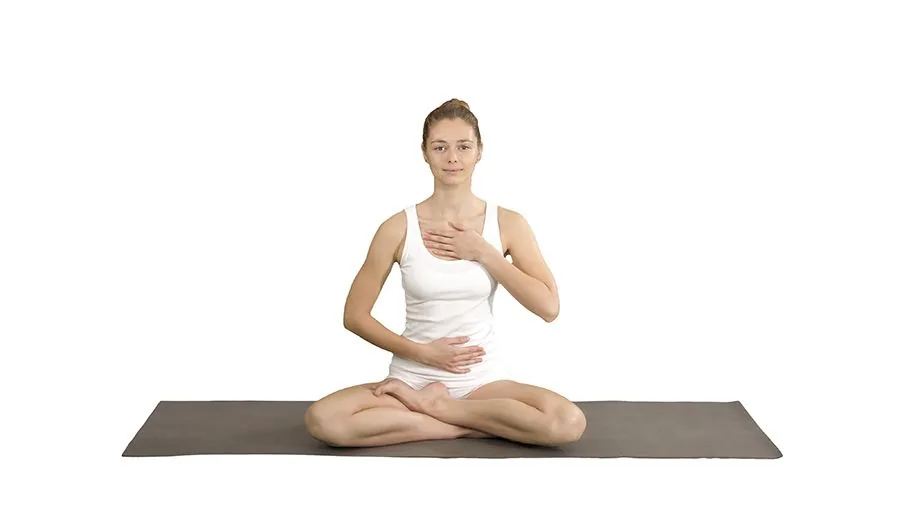
Diaphragmatic breathing is the least impressive exercise on this page and the one that matters most. Lie on your back with knees bent, a hand on your lower ribs. Breathe in and let the ribs widen sideways. Breathe out slowly and feel the deep abdominal wall draw in by itself.
That exhale is the pattern every later exercise is built on. Done for a few minutes twice a day, it reconnects a core that has spent nine months being stretched out of position.
Pelvic floor work, properly done
The pelvic floor took the weight of the pregnancy and, in a vaginal birth, the delivery itself. Leaking when you sneeze, cough or laugh is common afterwards and is not something to accept permanently.
A correct contraction feels like lifting and drawing in, as though stopping yourself from passing wind and then from passing urine. Your buttocks, thighs and stomach should stay still.
- Lift, hold for a few seconds, release fully, and rest as long as you held
- Add some quick lifts and releases for the fast reaction you need when you sneeze
- Twice or three times a day, and anywhere you are sitting
- Stop if it hurts, and ask about physiotherapy instead
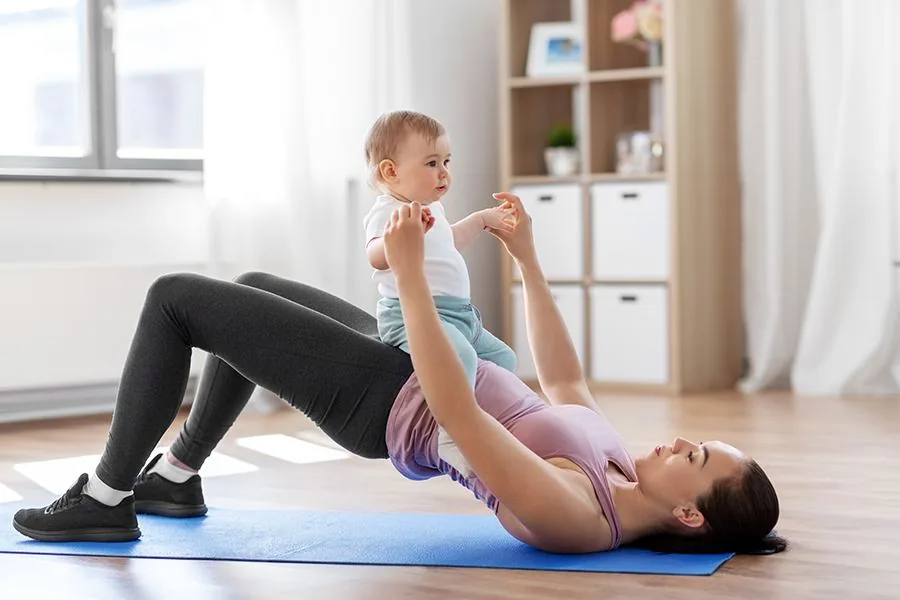
Women's health physiotherapy exists for this, and it is underused. KK Women's and Children's Hospital and National University Hospital both have services your doctor or polyclinic can refer you to, and persistent leaking, heaviness or a dragging sensation is a reason to ask.
What about the gap in your abdominal muscles?
Diastasis recti is the separation down the middle where the abdominal muscles parted to make room. Most women have some by the end of pregnancy. It usually narrows over the following months.
Check it yourself: lie down, knees bent, and press your fingers flat along the midline just above and below the navel while you lift your head slightly. You are feeling for width and for whether the tissue holds tension.
What to leave alone for now: crunches, sit-ups, full planks, double leg lifts and anything that makes the midline dome outward. Those load the midline before it can take it, and they do nothing to close the gap.
What to do instead: the breathing above, heel slides, pelvic tilts, side-lying work, and gradual loading once the midline holds. A physiotherapist can tell you when to progress.
How much, and how hard?
ACOG points to 150 minutes a week of moderate-intensity aerobic activity, and moderate means you can talk but not sing. The WHO's physical activity guidance and the Health Promotion Board's national guidelines land in the same place.
A schedule that survives a newborn:
| Week | What it looks like |
|---|---|
| 1 to 2 | Walking indoors, breathing work, pelvic floor lifts |
| 3 to 6 | Longer walks, heel slides, pelvic tilts, light upper body |
| 6 onwards | Cleared at your review, add swimming, cycling, resistance work |
| 12 onwards | Running and higher impact, if the pelvic floor is ready |
Running is the one worth being patient about. Impact loads the pelvic floor heavily, and going back to it before that recovers is how long-term leaking starts.
Also read: postpartum pain and what helps
Exercising in this heat
The climate is the obstacle nobody writes about, and it is a real one when you are already short of sleep.
- Train before 8am or after 7pm, when the sun is off the pavements
- Use the covered walkways and park connectors rather than open ground
- Air-conditioned ActiveSG gyms and shopping-centre loops both count as indoor options
- A pool is gentle on joints once you are cleared, and cooler than any land workout
- Drink more than you think you need, especially while breastfeeding
- Skip outdoor sessions altogether during a haze episode
Dizziness, a racing heart that will not settle, or a headache in the heat means stop and cool down rather than push through.
Confinement, rest and movement
Confinement practice asks you to stay in, stay warm and avoid exertion for about a month, and most of that is sound. Rest is genuinely restorative, and having somebody cook is worth more than any workout.
The part worth adjusting is total immobility. Lying still for weeks raises clot risk and stiffens everything, and no obstetric guidance supports it. Gentle walking indoors fits comfortably inside a confinement month, and so does breathing and pelvic floor work done lying down.
If a confinement nanny or a relative objects, the compromise is easy. Nothing strenuous, nothing outdoors, and movement every hour you are awake.
When should you stop and call someone?
Stop and contact your doctor if you get:
- Bleeding that gets heavier, or returns bright red after it had settled
- Pain in the abdomen, pelvis or a caesarean scar
- A bulge or heaviness in the vagina
- Leaking that is getting worse rather than better
- Dizziness, breathlessness out of proportion to the effort, or chest pain
- Calf pain or swelling on one side, which needs same-day assessment
Low mood deserves the same urgency as any of those. If you feel persistently flat, anxious or unable to cope, say so at your postnatal review, and say it to a doctor sooner if it is bad.
Frequently asked questions
- When can I start exercising after giving birth?
- ACOG says activity can resume gradually as soon as it is medically safe, with no fixed waiting period after an uncomplicated vaginal birth. After a caesarean or a complicated delivery, ask your own doctor before you begin.
- How much exercise should I aim for?
- ACOG points to 150 minutes a week of moderate-intensity aerobic activity in the postpartum period. Broken into 20 minutes a day, or a few brisk 10-minute walks, that is achievable with a newborn.
- Will exercise reduce my milk supply?
- The research ACOG reviewed found that moderate exercise does not affect supply. Feed or express before you train so you are comfortable, drink more than usual in this climate, and wear firm support.
- What is diastasis recti and can I do crunches?
- It is the gap left where the abdominal muscles separated to make room for the baby. Leave crunches, sit-ups and full planks until a physiotherapist or doctor says the midline is holding, because they can make it dome outwards. Deep core and breathing work come first.
- When can I swim again?
- Once bleeding has stopped and your doctor has cleared you, which is usually around the six-week check. Swimming while you are still bleeding is generally advised against because of the risk of infection.
Sources
Share this article
This article is for information only and is not a substitute for diagnosis or medical advice. Please talk to your doctor about your own situation.