
Pregnancy Exercise For Every Trimester In Singapore
How much exercise is safe in each trimester, how to train around Singapore's heat and haze, and the warning signs that mean stop and call.

Exercise is recommended through a healthy pregnancy. ACOG puts the target at about 150 minutes of moderate activity a week, spread across the days. In Singapore that usually means early mornings, a pool, or somewhere air-conditioned. Get clearance at your polyclinic or from your obstetrician first.
Is it safe to exercise while pregnant?
For most Mamas, yes, and the relatives who tell you to sit still have it backwards. ACOG states that physical activity does not raise the risk of miscarriage, low birth weight or early delivery in a healthy pregnancy.
The gains are concrete. Both ACOG and the NHS list less back pain, easier bowels, healthier weight gain, better sleep and a lower chance of gestational diabetes and pre-eclampsia. Staying active may also make it easier to get moving again after the birth.
Mood is the one nobody mentions at the antenatal visit. Regular movement can lift it, which matters in a first trimester spent exhausted and queasy. Our piece on improving your pregnancy mood goes further into that.
The clearance conversation is still worth having. Raise it at your next polyclinic or obstetrician appointment and describe what you actually plan to do, including how often and how hard.
How much, and how hard?
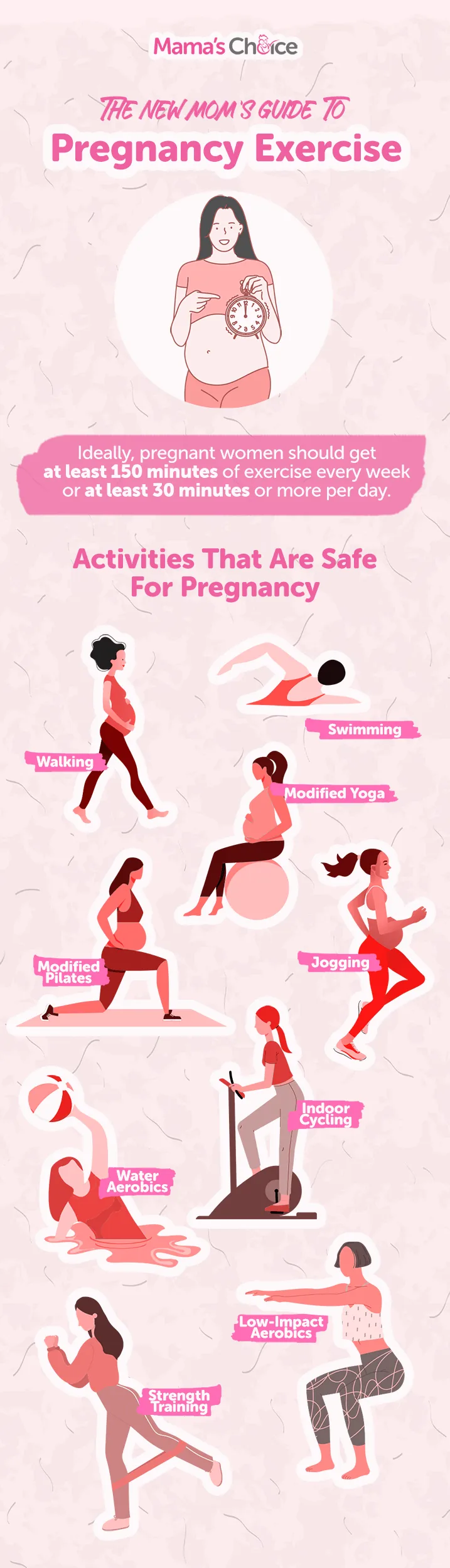
ACOG's figure is roughly 150 minutes of moderate aerobic activity weekly. Split it into half-hour sessions on most days, or into ten-minute blocks if that is what your schedule allows. The Health Promotion Board's guidance for pregnant women points the same way.
Judge intensity by the talk test. Moderate means you can hold a conversation while moving, though you would struggle to sing. If you cannot finish a sentence, ease off.
Already fit? Keep going, with adjustments. ACOG supports continuing an established routine rather than abandoning it, and that includes running and resistance work, at a load that suits each stage. New to all of this? Start with walking and build slowly.
When does exercise need to wait?
A minority of pregnancies genuinely call for rest. ACOG lists conditions where your obstetrician may advise against aerobic exercise, among them:
- Placenta praevia after 26 weeks
- Pre-eclampsia or pregnancy-induced high blood pressure
- Cervical insufficiency, or a cerclage in place
- Preterm labour or ruptured membranes in this pregnancy
- Severe anaemia
- Significant heart or lung disease
- Some multiple pregnancies at risk of preterm labour
None of this is for you to diagnose at home. Your doctor has your notes and your scans, which is why the clearance step comes first.
How do you train in heat like this?
Overheating is the risk that actually applies here, far more than any exercise on the list. The National Environment Agency puts most days around 30°C with high humidity and issues a heat stress advisory when conditions get worse, and sweat cools you poorly in air that damp.
Work around the weather rather than fighting it:
- Go out before 8am or after 7pm. The park connectors are empty and bearable at both ends of the day.
- Use the aircon. A gym, an indoor pool, a mall loop at opening time, or an exercise video in the living room all count.
- Drink before, during and after, not only when you feel thirsty.
- Stop at the first sign of dizziness, nausea, headache or feeling faint. Sit, cool down, drink.
- Skip hot yoga and hot pilates entirely. ACOG advises against both in pregnancy.
Haze season runs roughly June to October. Check the NEA readings before an outdoor session, and when the PSI or the one-hour PM2.5 figure sits in the unhealthy band, take the session indoors. That is a straightforward swap, and your lungs are already working harder than usual.
What works in each trimester?
| Trimester | What usually works | What to drop | Watch for |
|---|---|---|---|
| First | Brisk walking, swimming, prenatal yoga, light strength work, running if you already run | Contact sports, hot yoga, anything with a fall risk | Nausea and flattening exhaustion. A ten-minute walk still counts |
| Second | Swimming and water aerobics, stationary cycling, prenatal pilates, pelvic floor work | Long stretches flat on your back, deep abdominal twists, heavy overhead lifts | Your centre of gravity shifting as the bump grows |
| Third | Walking, swimming, water aerobics, stationary bike, pelvic floor work, gentle stretching | Jumping, sudden changes of direction, anything you cannot stop quickly | Pelvic girdle pain, breathlessness, Braxton Hicks |
Many Mamas find the second trimester the easiest to train in. Nausea has usually lifted, the bump is manageable, and energy returns for a few weeks.

Water deserves its own mention in this country. A condo pool or an ActiveSG public pool gives you exercise and relief from the heat in one go, and the water carries the weight your hips and lower back have been complaining about. Early evening, once the sun is off the deck, is the civilised time to go.
Pelvic floor exercises belong in every trimester and take no equipment or time. Do them while queuing, on the bus, at your desk. They can reduce leaking later, which is worth more than you might realise before you need it. Our guide to back pain during pregnancy covers the related stretches, and postpartum workouts picks up after delivery.
Where can you find prenatal classes in Singapore?
KK Women's and Children's Hospital and the National University Hospital both run antenatal programmes, and both have women's health physiotherapists who see pregnant patients for back and pelvic girdle pain. Ask for a referral at your antenatal visit rather than waiting for it to be offered.
Polyclinics can point you towards their own antenatal education and refer you onwards. Private prenatal yoga and pilates studios are easy to find across the island, though standards vary.
Ask the instructor one question before you pay: what prenatal qualification do you hold? A general yoga teacher improvising modifications for a bump is a different thing from someone trained for it. Tell them which trimester you are in and about any complications in your notes.
What should make you stop straight away?
Some symptoms end the session and start a phone call. Stop and contact your obstetrician or the delivery suite if you get:
- Vaginal bleeding, or fluid leaking
- Regular painful contractions
- Dizziness, feeling faint, or a headache that will not shift
- Chest pain, or breathlessness before you have even started
- Calf pain or swelling on one side
- Muscle weakness that affects your balance
Do not drive yourself anywhere if you feel faint. Call someone.
If you are already past 20 weeks and have done nothing so far, start tomorrow with a ten-minute walk after dinner, while it is cool. Mention it at your next antenatal appointment and ask whether anything in your notes should change the plan. Short and regular beats one ambitious Saturday that leaves you wrecked until Wednesday.
Frequently asked questions
- Can I keep running now that I am pregnant?
- Usually yes, if you were already a runner and your pregnancy is uncomplicated. ACOG supports continuing an established routine, with the load adjusted as your bump grows and your balance shifts. Confirm it with your obstetrician, and in this climate move your runs to before sunrise or onto a treadmill.
- How much exercise should I be getting each week?
- ACOG recommends about 150 minutes of moderate-intensity aerobic activity a week during a healthy pregnancy, spread across several days rather than crammed into one. Moderate means you can hold a conversation while you move. Anything is better than nothing if 150 minutes is out of reach.
- Is it safe to swim in a public pool while pregnant?
- Yes, and water is the kindest place to exercise in this heat because it takes the weight off your pelvis and joints. Skip diving, jumping in and hot tubs or jacuzzis. Watch your footing on wet tile, since your balance shifts as the bump grows.
- Should I exercise outdoors during haze season?
- Check the National Environment Agency readings before you go. When the PSI and PM2.5 figures sit in the unhealthy band, NEA advises reducing prolonged or strenuous outdoor exertion, and pregnancy is a sensible reason to take that seriously. Move the session into an air-conditioned gym or indoor pool instead.
- Do I need my doctor's approval before starting?
- Get clearance at your polyclinic or from your obstetrician before you begin, especially if you are new to exercise or have any pregnancy complication. It is a short conversation at an appointment you already have booked. A few conditions genuinely rule out exertion, and your notes will show them.
Sources
- ACOG — Exercise during pregnancy and the postpartum period
- NHS — Exercise in pregnancy
- Health Promotion Board — Physical activity guidance for pregnant women
- HealthHub (Health Promotion Board) — Keeping active during pregnancy
- National Environment Agency — Haze readings, PSI and the heat stress advisory
- KK Women's and Children's Hospital — Antenatal classes and women's health physiotherapy
- National University Hospital — Women's Centre antenatal programmes
Share this article
This article is for information only and is not a substitute for diagnosis or medical advice. Please talk to your doctor about your own situation.