
How to use breast milk storage bags properly
Storage times from the NHS and CDC, why Singapore's heat shortens the room-temperature window, and how to label, freeze and thaw a bag safely.
Expressed milk keeps for roughly four hours at room temperature, several days in a fridge and about six months in a freezer, and a bag only delivers that if you label it, lay it flat and thaw it gently. Singapore's heat pushes you towards the short end of every room-temperature figure.
How long does expressed breast milk keep?
Two authorities give the numbers you will see quoted most often, and they do not match perfectly. The CDC, in its guidance on storing and preparing breast milk, is the stricter of the pair. The NHS allows longer in a domestic fridge, provided you know the fridge genuinely holds four degrees Celsius or below. When the two disagree, the safer move is to follow the shorter figure, especially for a premature or unwell baby.
| Where the milk is | NHS guidance | CDC guidance |
|---|---|---|
| Room temperature, freshly expressed | Get it chilled or used promptly | Up to 4 hours |
| Cool bag with ice packs | Up to 24 hours | Up to 24 hours |
| Fridge at 4 degrees Celsius or below | Up to 8 days, or 3 days if you are unsure of the temperature | Up to 4 days |
| Freezer compartment inside a fridge | Up to 2 weeks | Not given separately |
| Chest or upright freezer at minus 18 degrees Celsius | Up to 6 months | Best within 6 months, acceptable up to 12 months |
| Thawed in the fridge, not yet warmed | Use within 24 hours | Up to 24 hours, never refrozen |
| Left in the bottle after a feed | Discard | Within 2 hours |
Note the last row. It catches people out constantly, because a half-finished bottle looks perfectly fine on the counter two hours later.
Why the heat here shortens the room-temperature window
The CDC's four-hour allowance is written for a room at around 25 degrees Celsius. Singapore does not have many of those. The National Environment Agency describes a climate that is uniformly hot and humid all year, with daily temperatures typically climbing past 31 degrees Celsius and relative humidity often above 80 per cent, and an HDB living room with the aircon off tracks that closely.
Warmer milk grows bacteria faster. So treat four hours as a ceiling you never approach rather than a target, and work on a rule of your own: into the fridge or the cool bag within the hour. Humidity matters for a second reason. Condensation on a bag you have just taken out of the freezer smudges marker ink and soaks any paper label you have stuck on.
Labelling a bag that lives in a shared fridge
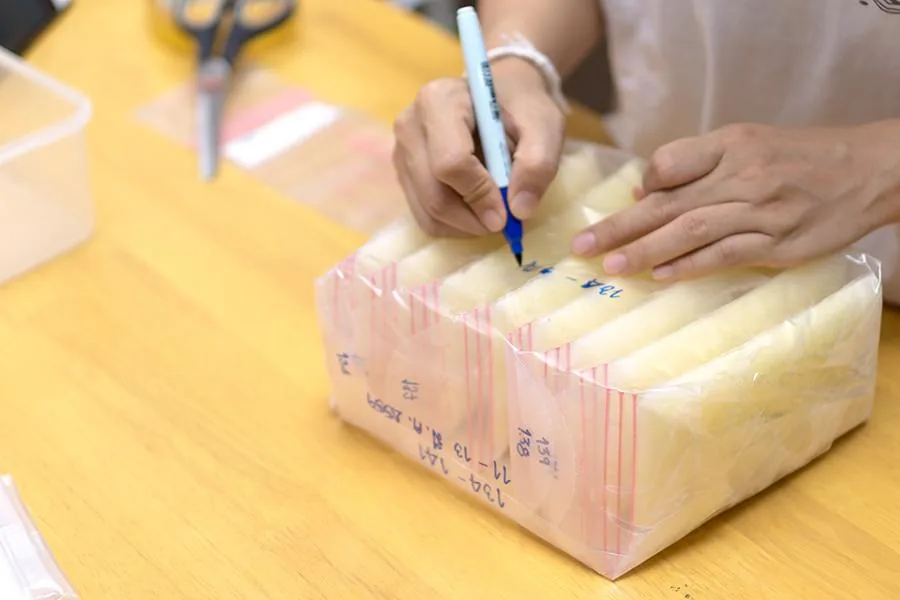
Write on the bag before you fill it, while it is dry and flat. Date, time and volume, in permanent marker, on the panel the bag provides for it. Add your name if the bag is going into an office pantry fridge, because an unlabelled bag of milk in a shared fridge is the one thing a colleague will feel entitled to move, bin, or ask loudly about.
A sealed container helps on every count. It keeps the bags upright, it stops them picking up the smell of someone's leftover curry, and it makes the whole stash one thing to carry rather than eight. Oldest in front. You want to reach for the right bag without reading six dates in a cold fridge.
Filling, sealing and freezing
Fill to about two thirds and no further, because milk expands as it freezes and a bag filled to the top splits at the seam. Press the air out before you zip it. Lay it flat on a tray in the freezer, and once it is solid you can file the slabs upright like books, which roughly doubles what fits in the small freezer of a typical HDB kitchen.
Freeze in small portions. A 60–120 ml bag that gets finished beats a 200 ml bag that leaves half to throw away. The CDC also warns against topping up a bag of frozen milk with warm fresh milk: chill the new milk in the fridge first, then add it.
Thawing and warming without wasting it
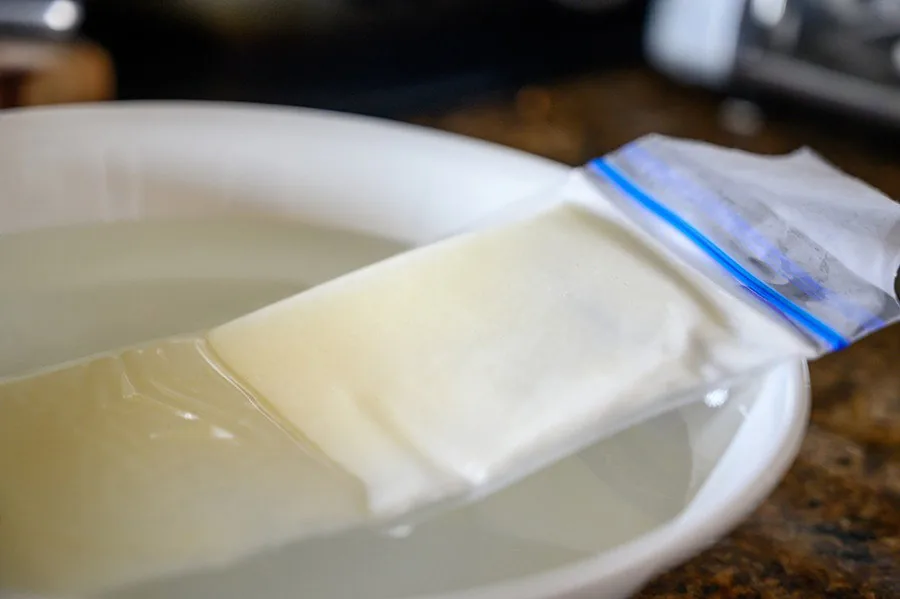
Overnight in the fridge is the gentlest method and the one that gives you the full 24-hour window afterwards. If you need it sooner, stand the sealed bag in a bowl of warm water or hold it under a warm running tap. Never put breast milk in the microwave. It heats unevenly, creates hot spots that can scald your baby's mouth, and the CDC advises against it outright.
Swirl, do not shake. The cream separates during storage and swirling brings it back together. Thawed milk sometimes smells soapy or metallic, which is a normal change in the milk fat and not a sign of spoilage, though some babies do refuse it. Once thawed, it never goes back in the freezer.
Getting milk home from the office
The commute is the weak link in the chain. A cool bag with frozen ice packs will hold milk for up to 24 hours according to both the NHS and the CDC. That is far longer than any journey across this island. An insulated bag packed with a couple of ice packs covers a bus ride, an MRT trip and a walk from the station in full sun. Pack it before you leave, not after you have stood in the lobby for 10 minutes.
If you are still working out the routine around the sessions themselves, the practicalities of expressing at work are worth reading alongside this, and storing breast milk while travelling covers longer journeys and flights. Many mothers arrive at a storage routine only after the supply question settles, which is its own topic in the archive's guide to expressing.
What to do when the power goes out
Power cuts in HDB blocks are usually short, and a freezer that stays shut will protect your stash through most of them. The FDA's food safety guidance for power outages is the useful rule here: keep the door closed, and a full freezer holds its temperature for around 48 hours while a half-full one holds for about 24. Do not open it to check. Opening it is the thing that costs you the milk.
When the power returns, judge each bag by ice rather than by clock. Bags that still contain ice crystals can go back to freezing. Bags that have thawed completely but are still cold belong in the fridge for use within 24 hours. Bags that are warm go down the sink, and it is worth the loss.
When to ask for help with the whole routine
Storage questions often turn out to be supply questions in disguise, or a latch problem that has pushed a mother into expressing more than she wanted to. Lactation consultants at KK Women's and Children's Hospital see exactly this. Your polyclinic can refer you, and HealthHub lists the breastfeeding support services available across the island. Leaking between sessions is another thing a consultant can sort out in one visit.
Before your next session, check the thermometer in your fridge and in the office fridge if there is one. A pantry fridge sitting at eight degrees Celsius is too warm for any of the fridge figures in the table above to apply.
Frequently asked questions
- How long does breast milk last at room temperature in Singapore?
- Take the shortest figure you see. The CDC allows freshly expressed milk up to four hours at room temperature, and that allowance assumes a room at about 25 degrees Celsius. A Singapore flat without aircon runs hotter than that for most of the day, so get the bag into a fridge or a cool bag quickly instead of leaving it on the counter.
- Can I refreeze breast milk that has thawed?
- No. The CDC says milk that has fully thawed should never go back into the freezer, and that it should be used within 24 hours once it has thawed in the fridge. Milk left in the bottle after a feed goes within two hours. Freeze in small amounts and you will throw far less away.
- Is it safe to keep my milk in the office fridge?
- Yes, and you do not need a separate fridge for it. Breast milk is food, so a shared pantry fridge is fine as long as the temperature holds at four degrees Celsius or below. Write your name, the date and the time on the bag, and put it in a sealed box at the back where the temperature is steadiest.
- How do I know if stored breast milk has gone off?
- Smell it and taste a drop. Milk that has separated into a cream layer is normal and swirls back together. Milk that smells sour or soapy-rancid after a swirl is not worth risking. Thawed milk often smells different from fresh, which is a change in the fat, not spoilage.
Sources
- CDC — Proper storage and preparation of breast milk
- NHS — Expressing and storing breast milk
- HealthHub (Health Promotion Board) — Breastfeeding and expressing milk
- National Environment Agency — Climate of Singapore
- FDA — Food safety during a power outage
- KK Women's and Children's Hospital — Lactation and breastfeeding support
Share this article
This article is for information only and is not a substitute for diagnosis or medical advice. Please talk to your doctor about your own situation.