
The right floor cleaner for a crawling baby
Which cleaning ingredients are worth avoiding once a baby is on the floor, how to read a label, and how to mop a Singapore flat without trapping fumes.
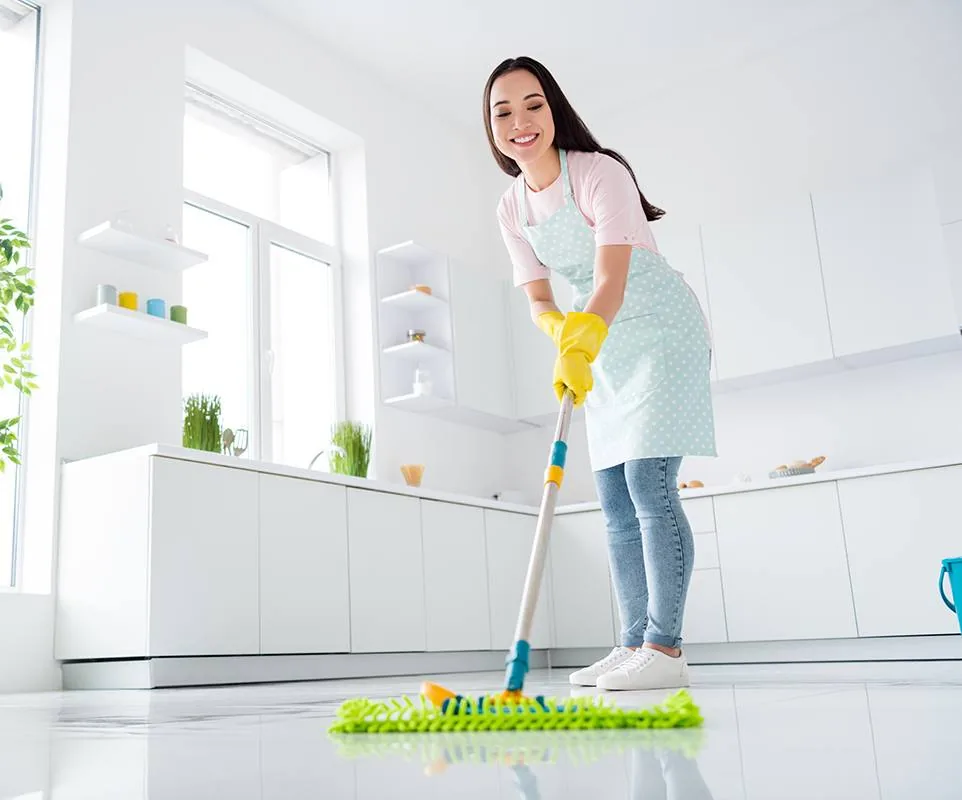
Once a baby is crawling, the floor becomes a surface she touches with her hands and then puts in her mouth. The CDC's advice for homes is to clean routinely with soap or detergent and to disinfect only when someone is ill. Plain detergent, a well-rinsed mop and an open window beat a stronger bottle.
Does a floor need disinfecting every day?
Cleaning and disinfecting are different jobs. Cleaning lifts dirt and most germs off a surface with detergent and water. Disinfecting kills what is left with a chemical that is, by design, meant to kill things.
The CDC tells households to clean regularly and to disinfect when there is a reason: someone in the flat is sick, raw meat has dripped, a diaper has leaked on the floor. Reaching for a disinfectant every day raises your baby's exposure without doing much more for her protection.
That matters more at crawling age than at any other, because she spends an hour at a stretch with her palms flat on whatever you last mopped with.
Which ingredients are worth avoiding?
Triclosan. An antibacterial agent that the FDA ruled could no longer be marketed in over-the-counter antibacterial hand soaps, citing a lack of evidence that it beat plain soap and open questions about long-term use. It still turns up in some household products.
Phthalates. Used to make scent linger. They rarely appear by name, because fragrance on a label can cover a mixture. The FDA notes that cosmetic labels may list fragrance as a single word, and household cleaners seldom break it down either.
Heavy fragrance of any kind. The strongest smelling floor cleaner on the shelf leaves the most residue in the air of a closed, air-conditioned room.
Chlorine bleach, used carelessly. Bleach is a genuinely effective disinfectant and the CDC publishes dilution and ventilation guidance for it. The danger is in the handling. Never combine it with an ammonia or acid-based cleaner, because the reaction releases a toxic gas.
Sodium lauryl sulfate gets grouped in with those, and it does not belong there. It is a detergent that can irritate skin on contact, which is a reason to rinse the floor rather than a reason to avoid the bottle.
Also read: what triclosan actually does
How do you read a label in a Singapore supermarket?
Most of the aisle tells you nothing useful, so look for the parts that do.
| On the label | What it tells you |
|---|---|
| A full ingredient list | The brand is willing to show you |
| "Fragrance" with no breakdown | A mixture you cannot check |
| "Rinse after use" | It is meant to be rinsed, so rinse it |
| "Keep out of reach of children" | Storage matters, not just the mop |
| Dilution instructions | Concentrates are cheaper and safer used correctly |
A plain detergent with a short list and a mild scent is usually the better buy. Guardian, Watsons, Unity and the supermarkets all stock fragrance-free options, and the own-brand version is often the simplest formula on the shelf.
How do you mop a flat without trapping the fumes?
Singapore homes run closed and cold for much of the day, which is comfortable and keeps whatever you sprayed in the room with you.
- Open the windows or turn the exhaust fan on while you work, then leave them open a while after
- Mop when your baby is out of the room, and keep her out until the floor is dry
- Wring the mop properly: a wet tile floor is slippery, and a crawling baby has no way of correcting a slide
- Rinse with clean water after a detergent pass, especially in the spots she favours
- Mix concentrates at the dilution printed on the bottle, not stronger
The drying rack is the spot most people forget. Water drips off laundry onto the same patch every day, and that patch stays damp in humid air.
What about shoes at the door?
Leaving shoes outside is already normal in Singapore, and it does more for a crawling baby than any cleaner does. Shoes carry in soil, lift residue, and whatever was on the lift floor.
Keep a basket for outdoor shoes and a spot for the stroller wheels. If a helper or a visitor does the shopping run, the rule only works if everybody knows it.
Also read: how to protect your baby from germs
Also read: disinfecting baby toys by toy type
Where cleaning products should live
The American Academy of Pediatrics puts storage at the centre of poison prevention, and a crawling baby is exactly the reason.
Bottles belong in a high cupboard or behind a latch, in their original containers, never decanted into a drink bottle. The under-sink cabinet is the easiest one in the flat for a baby to open and the one most households use.
If she swallows something, do not try to make her sick. Wipe her mouth out, bring the container and get her to a hospital emergency department. Call 995 if she is drowsy, struggling to breathe or having a fit.
Frequently asked questions
- Do I need to disinfect the floor every day?
- No. The CDC's guidance for homes is to clean with soap or detergent routinely and to disinfect only when someone is ill or a surface has been contaminated. For a healthy household, daily disinfecting adds chemical exposure for little extra protection.
- Is bleach safe to use in a flat with a baby?
- Diluted bleach is an effective disinfectant and the CDC publishes how to dilute and use it. Ventilate while you work, never mix it with ammonia or acid cleaners, and keep the baby out of the room until the floor is dry.
- What ingredients should I avoid in a floor cleaner?
- Triclosan, which the FDA ruled out of over-the-counter antibacterial soaps, strong fragrance, and anything you cannot identify on the label. Phthalates often hide behind the single word fragrance.
- Is sodium lauryl sulfate dangerous?
- It is a detergent, not a toxin. At the concentrations used in cleaning products it can irritate skin on contact, which matters for hands and knees on a wet floor. Rinsing and drying the floor properly deals with it.
- What do I do if my baby drinks some cleaning liquid?
- Do not make her vomit. Wipe out her mouth and take the bottle with you to a hospital emergency department. If she is drowsy, having trouble breathing or having a fit, call 995.
Sources
Share this article
This article is for information only and is not a substitute for diagnosis or medical advice. Please talk to your doctor about your own situation.