
How to start baby-led weaning safely
Readiness signs, safe shapes and seating, gagging versus choking, where iron comes from, and why a spoon can stay in the mix in a Singapore kitchen.
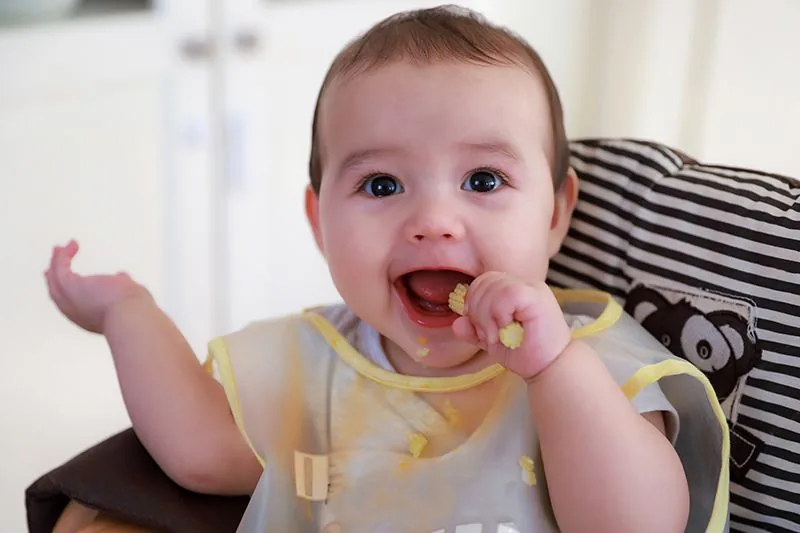
A strip of steamed sweet potato, a high chair, and a floor you have accepted will need mopping.
Baby-led weaning means offering soft finger-sized pieces of food from around six months and letting your baby feed herself instead of being spoon-fed purée. Start once she sits steadily and brings things to her mouth. Keep her upright, keep milk going, and put an iron-rich food on the tray every day.
What is baby-led weaning?
The idea is simple enough. Food arrives in pieces your baby can hold, and she decides what goes in her mouth, how fast, and when she has finished.
The NHS describes finger foods as suitable from the very start of weaning, alongside mashed and puréed food, so this has stopped being an alternative philosophy and become one normal option. Babies who feed themselves get practice at pincer grip, at judging how wide to open their mouths, and at stopping when they are full. They also get to touch everything, which is how a baby learns what a food is.
The costs are real ones. More mess, slower meals at first, and less certainty about how much actually went in. Some families love it. Some find it stressful and go back to a spoon, and that is a reasonable call.
When is a baby ready to start?
Around six months is the guidance from the World Health Organization and from HealthHub, with breastfeeding or formula continuing alongside. Earlier than that, a baby's swallow and gut are not ready for solid food.
The NHS lists the readiness signs: staying in a sitting position with a steady head, coordinating eyes, hands and mouth well enough to look at food and get it to her mouth, and swallowing food rather than pushing it back out. All of those should be there, not just one.
Self-feeding asks for a little more than spoon feeding does. Your baby needs enough trunk control to sit upright without slumping sideways, because a slumped baby cannot protect her own airway. If she still needs propping, start with a spoon and come back to finger food in a few weeks. The old rule about waiting until a baby has doubled her birth weight has no basis and can be ignored.
How do you cut and present food safely?
This section is the one that matters. Everything else about baby-led weaning is preference.
- Cut pieces about the length and width of your own index finger, so a fist can hold one with an end sticking out
- Cook anything firm until it squashes under gentle pressure between your finger and thumb
- Quarter grapes and cherry tomatoes lengthways, and take the stones out of longan, lychee and rambutan
- Leave out whole nuts, popcorn, raw apple and carrot sticks, hard sweets and chunks of sticky dried fruit
- Thin nut butter with water or milk before it goes anywhere near bread
- Seat your baby upright in a high chair with her feet supported, facing forward
- Never feed her in a car seat, a stroller, a carrier or lying back
- Stay at the table the whole time, and eat with her when you can
Two more habits help. One new food at a time, with a few days before the next, so you can tell what caused a reaction. And no distractions during the meal, since a baby watching a screen is a baby who has stopped paying attention to her mouth.
The American Academy of Pediatrics now advises introducing the common allergenic foods early rather than holding them back, so egg, peanut, dairy, wheat, soy, fish and shellfish belong in these first months. Thinned peanut butter on a strip of toast is a normal way to do it. If your baby has severe eczema or a known food allergy, ask your doctor before introducing peanut and egg. Any hives, swelling, vomiting or wheeze means stop and get medical advice the same day.
How do you tell gagging from choking?
Watch for noise. A gagging baby is loud, red in the face and plainly annoyed, and the gag reflex is doing exactly what it exists to do, which is push food forward and out. Her gag reflex sits further forward in the mouth than yours, so it triggers easily and often.
A choking baby makes no sound at all. No cough, no cry, nothing moving. She may go quiet, floppy or blue around the lips.
Coughing and spluttering mean leave her to finish the job while you stay close. Silence means act. Learn infant back blows and chest thrusts before your first meal rather than after, and keep a phone within reach because the ambulance number is 995.
Where does the iron come from?
Iron stores from pregnancy start running down at around six months, which is a large part of why solids begin at all. A tray of fruit and plain rice will not touch it.
Offer something iron-rich every day, in a shape she can grip. Soft minced meat pressed into a finger, flaked fish, mashed egg, dhal thickened enough to hold its shape, tofu, or iron-fortified infant cereal loaded onto a spoon she holds herself. Vitamin C alongside helps her absorb iron from plant sources, so a few pieces from our list of easy first fruits served at the same meal does double duty.
Milk remains the bulk of her nutrition for months. The World Health Organization recommends breastfeeding alongside solid food to two years and beyond, and a baby who suddenly drops several feeds while barely eating needs a check at the polyclinic.
Can you mix spoon feeding and self-feeding?
Yes, and most Singapore families end up doing exactly that. A loaded spoon at breakfast because you are rushing for the MRT, a strip of steamed pear in the evening when there is time to let her play with it.
Nothing is lost by mixing. A baby learns texture from lumps and purée as readily as from finger food, and the goal in the first year is a wide range of flavours and textures rather than loyalty to a method. Your confinement nanny, your mother and your helper may each have firm views on this. You are allowed a mixed approach.
Teething can make a self-feeder temporarily miserable, and sore gums put some babies off firm pieces for a week. Softer shapes and something cold to chew on cover the gap, and a teether is often more welcome than lunch. Extra wind and gassiness are common while her gut adjusts, and most of it passes.
What does this look like in a Singapore kitchen?
Steam, mash, serve. A small steamer basket over any pot handles sweet potato, pumpkin, broccoli florets with the stalk left as a handle, pear and chayote in under ten minutes, and a wet market stall will sell you single pieces rather than a pack of six.
Family food works better than separate baby food once you cook with the baby in mind. Keep the salt, stock cube, sauce and sambal out until her portion is lifted off, then season the rest for everyone else. Chicken rice cooked in stock, seasoned porridge from the coffee shop and most soups carry more salt than a baby's kidneys can clear, and the NHS is blunt about salty food in the first year.
Heat changes appetite, too. Many babies eat less on a sticky afternoon and drink more, and a few pieces of watermelon can be the whole meal some days. Offer water in an open cup with meals from six months, and expect most of it down her front.
When should you ask for help?
Some feeding problems need a professional rather than a forum. Ask if your baby coughs or splutters on thin liquids every time, if she arches and screams at the sight of food, if she is losing weight or has flattened off on the growth chart, or if she still cannot manage any texture at all by nine or ten months.
The polyclinic is the way in. Doctors there refer on to the dietitians, allergy clinics and feeding teams at KK Women's and Children's Hospital and the National University Hospital, and a lactation consultant can help if milk feeds have gone sideways while solids were starting.
Book an infant first-aid class before you start, not after a scare. The Singapore Red Cross and the private training schools run short sessions on back blows and chest thrusts for babies, and an hour of practice on a mannequin is worth more than every safe-shape rule on this page.
Frequently asked questions
- Is baby-led weaning safer or riskier than spoon feeding?
- Either way of feeding is safe when the food is the right texture and your baby is sitting upright, and either becomes risky with hard round pieces or a baby reclined in a stroller. Presentation and position matter far more than who is holding the food.
- How soft does a finger food need to be?
- Soft enough to squash against the roof of your mouth with your tongue, and soft enough to mark with gentle pressure between finger and thumb. Steamed carrot that still snaps is too firm. Cut pieces roughly the length of your own index finger so your baby can hold one and bite the end.
- My baby gags at nearly every meal. Is she choking?
- Gagging is loud, red-faced and protective, and it moves food back to the front of the mouth where she can deal with it. Choking is silent, because nothing is moving air. Noise and coughing mean leave her to it. Silence, blue lips or floppiness means act and call 995.
- Will my baby get enough iron if she feeds herself?
- Only if iron-rich food is on the tray. Iron stores run low at around six months, so offer soft meat, flaked fish, mashed egg yolk, dhal, tofu or iron-fortified cereal every day, in shapes she can actually pick up. Fruit and plain rice will not cover it.
- Can I give my baby food from a hawker centre?
- Take the plain parts. White rice, plain porridge, steamed fish or an unsauced vegetable from your own plate are fine, and the salt, stock, sambal and sauces are the problem. Soup and seasoned porridge carry more salt than a baby's kidneys can clear in her first year.
Sources
- NHS — Your baby's first solid foods, including finger foods and gagging
- WHO — Infant and young child feeding: complementary feeding and continued breastfeeding
- AAP, HealthyChildren.org — Starting solid foods, choking prevention and allergenic foods
- HealthHub (Health Promotion Board) — Starting your baby on solid food
- KK Women's and Children's Hospital — Paediatric dietetics and feeding support
Share this article
This article is for information only and is not a substitute for diagnosis or medical advice. Please talk to your doctor about your own situation.