
Easing body pains during pregnancy in Singapore
Why pregnancy hurts in the back, hips and pelvis, what helps at home, which painkillers are safe, and how to reach physiotherapy in Singapore.
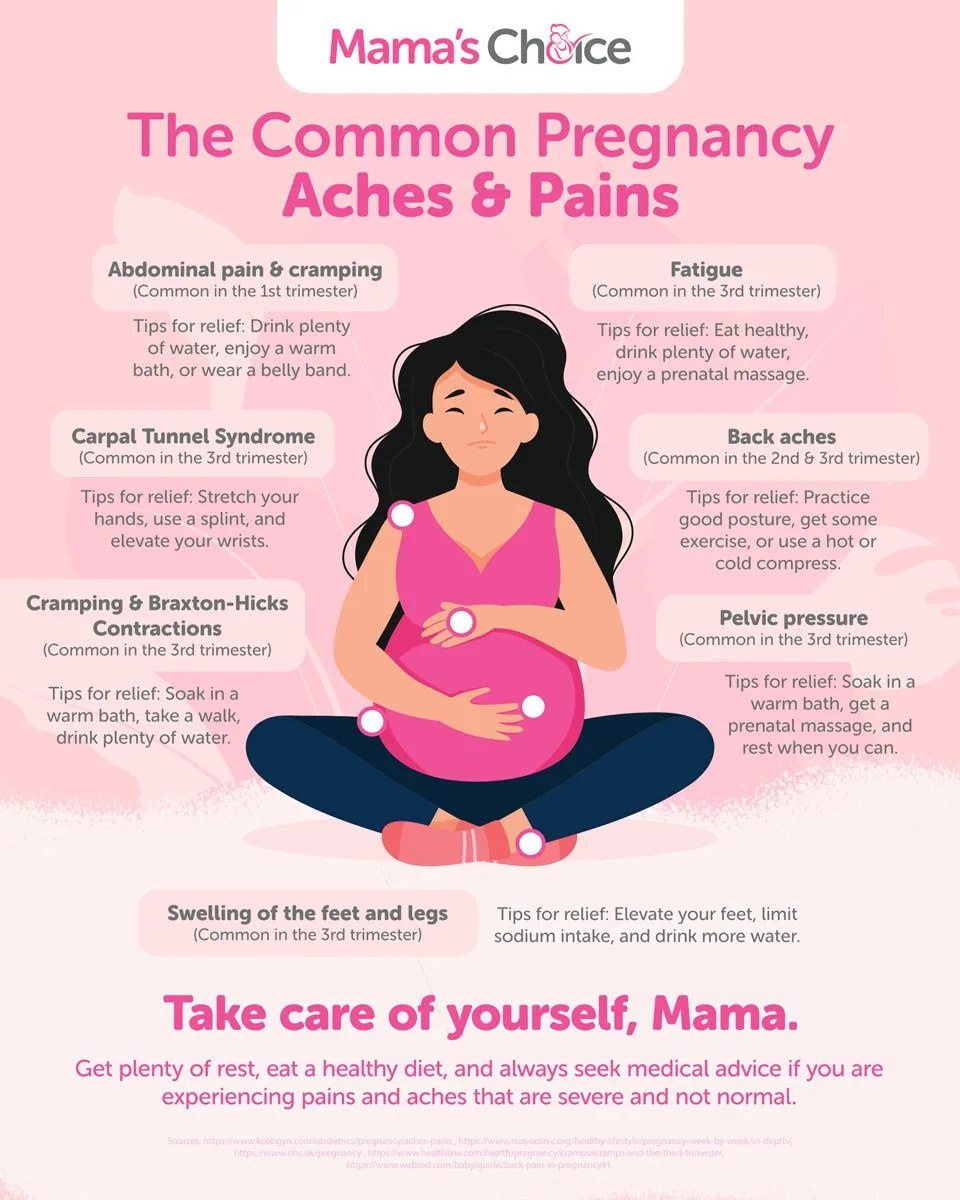
Most pregnancy pain comes from a body reshaping itself around a growing uterus, and most of it answers to posture, movement, local heat and rest rather than to anything you buy. Massage and topical oils can briefly make a sore muscle feel better. Neither fixes the cause, and a few kinds of pain need a doctor the same day.
Why pregnancy hurts in the first place
Two things change at once. The hormones of pregnancy soften the ligaments holding your pelvis together, and the bump pulls your centre of gravity forward so the muscles along your spine work harder just to keep you upright. The NHS names both of those as the reason back pain is so common in pregnancy. Load lands on joints that have gone deliberately loose.
Singapore adds a few of its own. You are carrying more weight in heat and humidity all year, you are probably standing on the MRT at eight in the morning because nobody looked up, and you spend the rest of the day in an office cold enough to stiffen anything that already aches. Swelling is worse in the heat. Swollen wrists make the carpal tunnel tighter, and tired muscles ache more by evening.
There is a free "May I have a seat" card and lanyard for exactly this, handed out at MRT passenger service centres. Use it. Asking out loud at the fifth stop is harder than it sounds.
Where the pain usually sits
| Pain | What it feels like | Why it happens |
|---|---|---|
| Lower back | A dull ache across the small of the back, worse by evening | Softened ligaments and a forward-shifted posture |
| Pelvic girdle | Pain over the pubic bone, in the groin or across the back of the pelvis, sometimes with a clicking | Pelvic joints moving unevenly |
| Round ligament | A sharp, short stab low on one side when you stand up fast, sneeze or roll over | Ligaments supporting the uterus stretching |
| Sciatica-type | Pain running from one buttock down the back of the leg | Pressure or irritation around the sciatic nerve |
| Hip | Soreness on whichever side you slept on | Hours of side-lying on a firm mattress |
| Wrist and hand | Numbness, pins and needles, a weak grip, worst at night | Fluid retention squeezing the median nerve |
Pelvic girdle pain is the one most often filed away as ordinary backache. The NHS describes it as pain over the pubic bone, across the lower back or deep in the groin, and says it can be treated at any point in pregnancy. Getting assessed early matters. Left alone, walking tends to get harder rather than easier.
Round ligament pain has a different character. ACOG describes it as a brief, sharp pull low in the abdomen, set off by a sudden movement, and most common in the second trimester. It passes in seconds. A low pain that settles in and stays is a different conversation.
If back pain is your main problem, our longer guide to back pain during pregnancy goes trimester by trimester.
What actually helps at home
Nothing on this list is dramatic. Taken together it is most of the relief available without a prescription.
- Move little and often instead of resting completely. The NHS lists gentle exercise, walking and exercise in water among the things that ease pregnancy back pain.
- Bend at the knees to lift, keep the load close to your body, and turn your feet instead of twisting your spine.
- Sit with the small of your back supported and both feet flat on the floor. A rolled towel behind you does the job.
- Sleep on your side with a cushion between your knees.
- Take stairs one at a time and keep your knees together when you turn over in bed, which the NHS recommends specifically for pelvic girdle pain.
- Wear flat shoes with a cushioned sole and leave the unsupportive ones for after.
Heat is safe where it stays local. A warm shower, a hot water bottle wrapped in a towel, or a heat pack across the lower back warms one patch of skin and nothing else. What the NHS advises against in pregnancy is anything that lifts your whole core temperature, which rules out saunas, steam rooms, jacuzzis and very hot baths for the entire nine months. In a country where most of us shower twice a day, that is an easy rule to keep.
Cold has its place too. ACOG suggests alternating heat and cold on a sore back, and a cold pack is often kinder on an inflamed wrist than heat is.
Is a prenatal massage worth it?
Massage will not unlock a stiff pelvic joint or free a compressed nerve. It does loosen the muscles that have spent weeks bracing around the problem, and for plenty of women that is the difference between sleeping and not sleeping. Judge it on that.
Prenatal massage is easy to find here. Most spas offer it, as do many neighbourhood TCM and reflexology shops. Say you are pregnant when you book, along with how many weeks, rather than mentioning it once you are already on the table. Several places decline first-trimester bookings outright, which is house policy rather than a medical rule.
Ask for side-lying with support under the bump and between the knees. Ask for light to moderate pressure over the lower back and none at all on the abdomen. Our older walkthrough of prenatal massage covers what a session actually involves.
Cost is the catch. A session runs at private-spa rates, and the CPF Board limits MediSave to approved medical treatment, which does not include spa services. If your pain is bad enough to need treating every week, that money goes further at a physiotherapist.
What about oils, balms and medicated rubs?
Topical oils are the most popular self-treatment in any Singapore household and the most oversold. Rubbing something warm into a sore muscle genuinely feels good. Most of that comes from the rubbing and from the sensation of warmth on skin, which is real relief and a short one.
Read the label before you commit to anything. Aromatherapy oils and massage balms are sold here as cosmetics, and the Health Sciences Authority regulates cosmetics by notification rather than by approval. Nobody at HSA has tested a notified product for use in pregnancy. The company behind the bottle is making that call on its own.
A few rules hold whatever you pick. Never swallow an essential oil. Dilute it in a carrier oil before it touches skin, patch test on your forearm and wait a day, and ask your own doctor or midwife about anything you plan to use daily. The lists of pregnancy-unsafe oils that circulate online mostly come from aromatherapy sources rather than regulators, and they do not agree with each other.
Strong medicated rubs deserve the most caution. Anything that smells of camphor or menthol hard enough to clear a room is a concentrated product, and concentration is the whole issue.
Which painkillers are safe in pregnancy?
Paracetamol first. The NHS treats it as the usual choice for pain in pregnancy, at the lowest dose that works and for the shortest time that works. Ibuprofen and the other anti-inflammatories sit in a different category, and the NHS advises against them in pregnancy unless your doctor has said otherwise, particularly from 30 weeks, because of their effect on the baby's circulation and on the fluid around the baby. The US Food and Drug Administration puts its own warning earlier, from about 20 weeks.
Stronger painkillers are a prescription conversation. Codeine, muscle relaxants and anything you were taking before you conceived all need checking rather than assuming. The same caution applies to medicated plasters off the shelf at Guardian or Watsons, since many of them carry an anti-inflammatory drug through the skin.
When pain needs a doctor rather than a rub
Most pregnancy aches are mechanical, dull and boring. Call your polyclinic, your obstetrician or the KKH or NUH delivery suite the same day if any of this shows up.
- Severe or sudden back pain, or back pain with a fever or burning when you pass urine, which can point to a kidney or urine infection.
- Pain in one calf with swelling, warmth or redness. Pregnancy raises the risk of clots, and that one is urgent.
- Severe pain under the ribs, especially alongside a bad headache, blurred vision or sudden puffiness in your face and hands.
- Regular tightening across the bump before 37 weeks.
- Any bleeding or leaking fluid together with the pain.
- Pain that stops you putting weight on one leg.
- A noticeable change in how much your baby is moving.
Panic helps nobody. Being seen does, and a same-day polyclinic slot costs very little next to the alternative.
Getting physiotherapy without paying private rates
Physiotherapy has the strongest claim on pelvic and back pain in pregnancy, and it is the thing many women here reach for last. Start at the polyclinic. A polyclinic doctor can refer you into the public system, KK Women's and Children's Hospital runs a women's health physiotherapy service built for this, and National University Hospital has its own. That referral is also what puts you on subsidised rates.
A session is usually an assessment, a short set of exercises for the pelvic floor and deep abdominal muscles, and advice on how to move through an ordinary day. Some women get fitted with a support garment. It is unglamorous work, and it goes after the cause in a way no rub can.
For the wider business of swollen feet, bad sleep and a third-trimester body that no longer fits its own furniture, our guide on staying comfortable during pregnancy covers more ground, and pregnancy exercise by trimester handles the movement side.
One practical thing to do next. Ask for the physiotherapy referral at your next antenatal appointment instead of waiting for a bad week, because the public queue is counted in weeks and your back is counting in days.
Frequently asked questions
- Can I have a massage while I am pregnant?
- Usually yes. Tell the therapist you are pregnant and how many weeks along you are when you book, ask to lie on your side, and ask for light pressure over the lower back. Some spas in Singapore decline first-trimester bookings as a house policy. Skip massage entirely if you have bleeding, pre-eclampsia or a known clotting problem, and ask your doctor first.
- Is paracetamol safe for back pain in pregnancy?
- The NHS treats paracetamol as the usual choice for pain in pregnancy, taken at the lowest dose that works and for the shortest time. Ibuprofen and the other anti-inflammatories are the ones to leave alone unless your doctor says otherwise. The NHS singles out 30 weeks onwards, and the US Food and Drug Administration has warned against them from about 20 weeks.
- Can I use a hot water bottle on my back while pregnant?
- A warm compress on one patch of skin is fine. What the NHS advises against in pregnancy is anything that raises your whole body temperature, so saunas, steam rooms, jacuzzis and very hot baths are out. Wrap a hot pack in a towel so it never sits directly on skin.
- How do I get physiotherapy for pelvic pain in Singapore?
- Ask your polyclinic doctor or your obstetrician for a referral. KK Women's and Children's Hospital runs a women's health physiotherapy service and National University Hospital has one too. A referral is also what puts you on subsidised rates rather than private ones.
- Will the pain go away after I give birth?
- For most women the pelvic and back pain settles over the weeks after delivery as the ligaments firm up again. Pain that is still limiting how far you can walk at the six-week check is worth raising then. It responds to the same physiotherapy.
Sources
- NHS — Back pain in pregnancy
- NHS — Pelvic pain in pregnancy
- NHS — Which painkillers can you take during pregnancy
- NHS — Things to avoid during pregnancy
- ACOG — Back Pain During Pregnancy
- KK Women's and Children's Hospital — Women's Health Physiotherapy
- Health Sciences Authority — Cosmetic product notification in Singapore
- CPF Board — MediSave
Share this article
This article is for information only and is not a substitute for diagnosis or medical advice. Please talk to your doctor about your own situation.