
Should your baby use a flat head pillow?
Flat head pillows are widely sold in Singapore, and no health authority recommends one. What prevents a flat head, and when to ask for a referral.
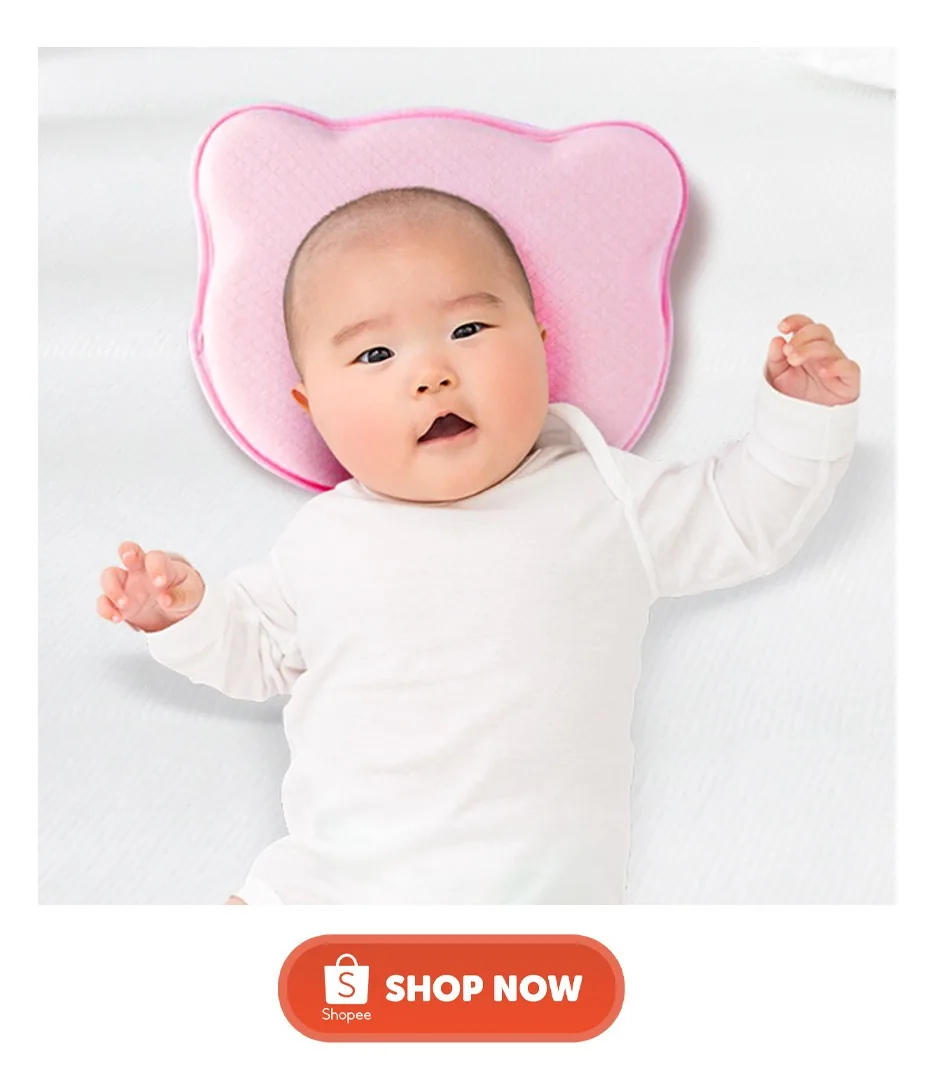
Flat head pillows sell well on every Singapore marketplace, and no paediatric authority recommends one. Safe sleep guidance is a bare cot, and a contoured pillow is still an object in it. What shifts head shape is changing position during waking hours, plenty of supervised tummy time, and less time lying in a seat.
Do flat head pillows do anything?
The pitch is reasonable on its face. A hollow in the middle of a cushion takes pressure off the back of the skull, and that is where a flat spot forms.
The problem is that nobody with responsibility for infant safety endorses it. The American Academy of Pediatrics states the sleep surface should be firm and flat with a fitted sheet and nothing else, and the NHS says the same. Neither names a pillow as a treatment for head shape, and neither lists one among the things that help.
If you were searching for the best one, the category has no winner. The measures that work are free.
Why is a pillow a problem in the first year?
Anything soft in a cot can shift. A baby who has rolled or wriggled can end up face down against a raised contour, and at an age when she cannot reliably lift and turn her own head that is how airways get blocked.
The United States Food and Drug Administration has gone further on a related category, warning parents off infant sleep positioners and wedges after deaths were reported with them in use. A head-shaping pillow is not the same product, and it sits in the same cot and raises the same question.
The things that belong in a cot are short enough to list.
| In the cot | Not in the cot |
|---|---|
| A firm, flat mattress | Pillows and head cushions |
| One fitted sheet | Duvets and quilts |
| Your baby, on her back | Cot bumpers, wedges, positioners |
| A thin swaddle or sleep bag | Soft toys and loose blankets |
What actually prevents a flat head?
Pressure causes it, so the fix is to spread the pressure around.
Alternate which end of the cot you lay her down at. Babies turn towards the room, the door, the sound of you. Swap her head and feet every few nights and she will turn the other way.
Change the arm you feed on. Even if you bottle feed, switch sides each time. It changes which side of the head rests against you.
Carry more, recline less. Singapore families spend long stretches with a baby in a car seat, a stroller or a rocker, partly because of the heat and partly because of the distances. Every one of those puts the back of the head against a hard surface. A carrier, or simply your shoulder, does not.
Supervised tummy time while awake. The single most useful habit, and the one most often skipped.

How much tummy time, and from when?
From the first weeks, says the American Academy of Pediatrics, in short bursts while your baby is awake and you are watching.
Start with a minute or two after a diaper change, a few times a day, and build up as she gets stronger. Most babies protest at first. Lying on your chest while you recline counts, and so does lap time across your knees.
A cool floor helps here. Tummy time in a warm room with a baby who is already sweating ends quickly, so pick the air-conditioned hour rather than the middle of the afternoon on the balcony side.
Also read: why crawling matters for babies
When should a flat spot be looked at?
Head shape is checked at the routine developmental visits in the first year, so a polyclinic or GP appointment is the place to raise it. Ask sooner if:
- Your baby always turns her head the same way and resists turning the other, which can mean a tight neck muscle
- One ear sits noticeably forward of the other
- The forehead is bulging on one side
- The flattening is getting worse after four months rather than holding steady
- There is a ridge along the skull, or the soft spot has closed early
A persistent head turn is worth acting on quickly, because neck physiotherapy is straightforward and works better early. Your doctor can refer you to KK Women's and Children's Hospital or National University Hospital for that assessment.
Is a helmet ever the answer?
Sometimes, and it is a clinical decision rather than a shopping one. Helmet therapy is considered for moderate or severe flattening that has not responded to repositioning, and it is fitted and monitored by a specialist within a particular age window.
Most babies never need one. The NHS describes flat head as common and says shape generally improves on its own, which is also why a specialist will often ask you to try repositioning properly for a couple of months first.
Also read: is flat head syndrome dangerous
What to say to whoever else puts her down
A confinement nanny, a grandparent or a helper may arrive with a firm bean pillow and real confidence about it. That advice was mainstream once.
Give them the rule and the reason in one breath. Bare mattress, back, nothing under the head, because anything with a contour can end up over the face. Then give them the job that does help, which is tummy time whenever she is awake and happy on the mat.
Frequently asked questions
- Do flat head pillows work?
- No health authority recommends one. Safe sleep guidance from the American Academy of Pediatrics is a firm flat surface with nothing on it, and a contoured pillow is still something in the cot. Repositioning and tummy time are the measures with evidence behind them.
- At what age can a baby use a pillow?
- Keep the cot bare for the first year. After that a pillow is usually introduced when a child moves to a bed, and a thin one is enough.
- Will a flat spot correct itself?
- Usually, yes. The NHS describes flat head as common and says head shape generally improves on its own by around the second year, as a baby spends more time sitting and standing and the skull grows.
- Is back sleeping still right if it flattens the head?
- Yes. Putting a baby to sleep on her back is the most important known way to lower the risk of sudden infant death, and no paediatric body has revised that advice because of head shape. You change what happens during waking hours instead.
- Where do I go in Singapore if I am worried about head shape?
- Raise it at a polyclinic or with your GP, who can refer you on. KK Women's and Children's Hospital and National University Hospital both assess head shape and neck movement in infants.
Sources
- American Academy of Pediatrics (HealthyChildren) — A parent's guide to safe sleep
- American Academy of Pediatrics (HealthyChildren) — Positional plagiocephaly and flat head
- NHS — Plagiocephaly and brachycephaly (flat head syndrome)
- FDA — Consumer update on infant sleep positioners
- HealthHub (Health Promotion Board) — Baby's growth and development
Share this article
This article is for information only and is not a substitute for diagnosis or medical advice. Please talk to your doctor about your own situation.