
Benefits of crawling for babies in Singapore
Crawling builds hips, shoulders and problem solving, and plenty of babies skip it. The real milestone window, plus how to make a tiled flat safe.
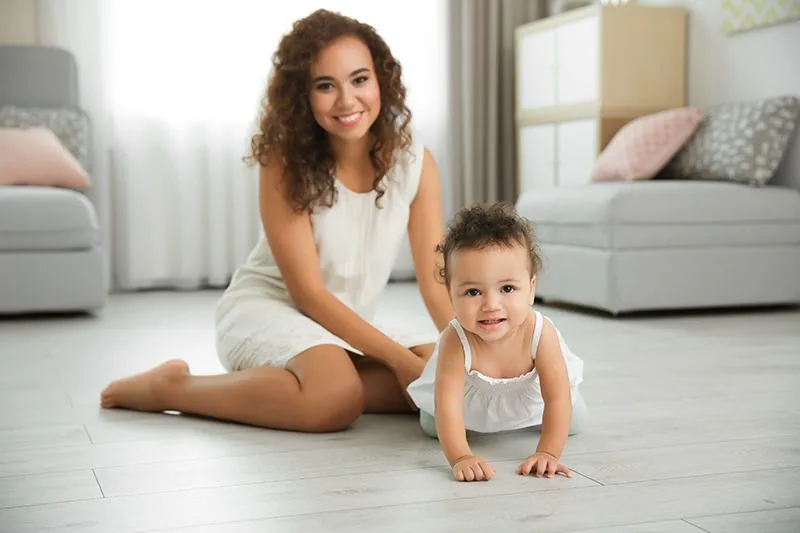
One morning she is parked on her tummy, complaining about it. By that evening she has reached the shoe rack.
Crawling helps strengthen a baby's hips, shoulders and hands, sharpens her sense of distance, and gives her a way to solve small problems on her own. Most babies start somewhere between six and ten months. A baby who bum shuffles, or who goes from sitting straight to pulling up, is usually developing perfectly well.
What does crawling do for a baby?
Getting up onto hands and knees asks a lot of a small body. The hips carry weight in a position they have never held. Shoulders learn to stay steady while the hands move underneath them.
That shoulder work is the part most parents miss. Crawling babies push through their palms and shift weight from one arm to the other, which builds the steadiness later needed for a spoon, a crayon or a zip. The hands get stronger because the arms are doing something hard.
Then there is the thinking. A baby who wants the remote control on the far side of a coffee table has to pick a route, give up on it when the table leg wins, and try another. Moving towards an object and away from it, dozens of times a day, is also how she learns to judge how far away things are. Nobody teaches that.
Exploration counts as much as the muscles. Once your baby can reach the thing she had only stared at from her cot, her whole day changes shape. She also starts putting all of it in her mouth, which is its own developmental stage rather than a bad habit.
When do babies start to crawl?
The window is wide. The World Health Organization's motor development study followed hands-and-knees crawling across several countries and found healthy children reaching it from around five months to well past their first birthday. The American Academy of Pediatrics describes most babies crawling between six and ten months.
In Singapore your baby's development gets a look at the routine polyclinic visits, and what the doctor observes goes into the health booklet beside the immunisation record. The six-month appointment is a sensible moment to raise anything nagging at you. Say it even if it sounds small.
One detail is worth knowing. The milestone checklists that the United States Centers for Disease Control and Prevention published with the American Academy of Pediatrics in 2022 do not mention crawling anywhere, because too many healthy babies take a different path to walking for it to be a useful checkpoint.
What if your baby skips crawling?
Plenty of babies do. Some commando crawl on their bellies for a month and then simply stand up. Others shuffle along on their bottoms with one leg tucked under, which looks odd and works beautifully. A few spend hardly any time on the floor and go from sitting to cruising along the sofa.
Skipping crawling on its own is not a delay, and there is no good evidence that it predicts problems with coordination, sport or school later on. The overall picture is what counts. Is your baby finding ways to move, using both sides of her body, and adding something new each month?
Ask for help sooner if she never uses one arm or one leg, if she feels stiff or unusually floppy, if she loses a skill she had, or if she still cannot bear weight on her legs at around ten months. Polyclinic doctors refer on to the child development services at KK Women's and Children's Hospital and the National University Hospital, and both would rather see a baby early than late.
Which crawling styles are normal?
The American Academy of Pediatrics lists a handful, and every one of them gets a baby across the room.
- Classic cross crawl on hands and knees, with the opposite hand and knee moving together
- Bear crawl on hands and feet, elbows and knees held straight
- Commando or belly crawl, dragging forward on the tummy
- Bottom scooting, pushing along in a sitting position
- Crab crawl, one knee bent and the other leg pushing sideways
- Rolling, which is slow and surprisingly efficient
Style matters far less than symmetry. A baby who drags the same side every single time is worth mentioning at the next visit.
How do you make a tiled flat safe for crawling?
Most homes here have hard floors. Polished tiles and vinyl mop up easily and are unforgiving when a head meets them, so a foam mat in the main play area earns its keep. Lay it where your baby actually plays, not where it suits the furniture.
Now get down on your own hands and knees and look at the room from 30 centimetres up. Trailing phone chargers, the gap beside the fridge, the rubbish bin, a wobbly drying rack, sockets at skirting height, detergent pods under the sink. You will find things you had stopped seeing.
Floors get dusty fast with windows open, and a crawling baby collects all of it on her palms before her palms go in her mouth. Hand washing after floor play does most of the work. Water and a mild cleaner are plenty for the daily mop. Save the disinfectant for the days after a stomach bug, or for a toy that has been on a lift lobby floor. Our guide to floor cleaners for a crawling baby covers what to keep off a surface your baby licks.
Mosquito bites tend to land on ankles and feet, which happens to be where a crawling baby lives. Keep floor play away from standing water, including the tray under a potted plant and the bottom of a drying rack, and read up on the signs of dengue before fever season catches you out.
How much floor time does a baby need?
Tummy time in the early weeks builds the strength crawling later spends. The World Health Organization's physical activity guidelines for children under five ask that babies who are not yet mobile spend at least 30 minutes a day lying on their front, spread across the day while they are awake. Thirty minutes sounds impossible until you split it into five-minute goes.
Babies who hate tummy time often just hate the floor. Try your chest, or your lap across your knees, or a rolled towel under the armpits. A mirror helps. So does an older sibling.
The American Academy of Pediatrics advises against infant walkers, and the reasoning is sound. A walker moves a baby around without asking her body to do the work, and it delivers her to hot drinks and open doors at a speed you cannot match. Time on the floor within sight of you teaches more, and it costs nothing.
When should you see a doctor?
Most crawling worries end up being nothing at all. A few are worth a same-week appointment.
Go if your baby stops doing something she could do, if her head control is poor when she sits, if her legs cross stiffly when you hold her upright, or if she shows no interest in moving towards anything by about ten months. Bring the health booklet so the doctor can see the pattern rather than a single afternoon. If a flat head is part of your worry, the positional side of it often improves once a baby is up on her hands and knees.
Keep your baby barefoot indoors while she is learning. Socks slide on polished tiles, and the soles of her feet are how she reads the floor. Save shoes for outside, and pick the softest pair that will stay on.
Frequently asked questions
- At what age should I worry that my baby is not crawling?
- Crawling itself is not the thing to watch. Raise it at the polyclinic if your baby cannot bear weight on her legs by around ten months, always uses one side of her body, feels stiff or floppy, or has lost a skill she already had. Those signs matter more than the date she first moves forward.
- Does skipping crawling cause problems later?
- There is no good evidence that it does. The milestone checklists the United States Centers for Disease Control and Prevention published with the American Academy of Pediatrics in 2022 leave crawling off the list, because so many healthy babies reach walking by another route.
- Is a baby walker a good way to get my baby moving?
- The American Academy of Pediatrics advises against infant walkers. They let a baby travel without building the strength that travelling normally requires, and they carry her towards hot drinks, open doors and stairs faster than you can cross the room.
- How clean do my floors need to be for a crawling baby?
- Clean enough, rather than sterile. Mopping with water and a mild cleaner handles ordinary dust, and washing your baby's hands after floor play does most of the rest. Keep a disinfectant for the days when somebody in the flat has been ill.
- My baby only crawls backwards. Is that normal?
- It is very common. Arms are stronger than legs at first, so pushing is easier than pulling, and backwards travel usually sorts itself out within a few weeks. Put a toy just out of reach in front of her rather than behind.
Sources
- AAP, HealthyChildren.org — Baby crawling styles
- WHO Multicentre Growth Reference Study — Windows of achievement for six gross motor milestones
- WHO — Guidelines on physical activity, sedentary behaviour and sleep for children under 5 years of age
- CDC and AAP — Learn the Signs. Act Early. developmental milestone checklists, 2022 revision
- HealthHub (Health Promotion Board) — Child development and the health booklet
- KK Women's and Children's Hospital — Child development service
Share this article
This article is for information only and is not a substitute for diagnosis or medical advice. Please talk to your doctor about your own situation.