Breastfeeding with flat or inverted nipples
Flat and inverted nipples make latching harder rather than impossible. How to shape the nipple, fix the latch, and find lactation help in Singapore.

Flat and inverted nipples make the first latch harder, and they rarely make breastfeeding impossible. Your baby needs a mouthful of breast rather than a nipple to hold. Shaping the areola, softening a full breast and fixing the depth of the latch solve most of it within the first fortnight.
What counts as a flat or inverted nipple?
A flat nipple sits level with the areola and stays there when stimulated. An inverted nipple goes the other way and pulls inward, sometimes retracting further when you press the areola behind it.
Many mothers have one of each. That is normal.
You can check at home. Compress the areola gently about two centimetres back from the base of the nipple. A nipple that comes forward will usually work with small adjustments. One that pulls away needs a little more patience.
Can you actually breastfeed with them?
Most mothers can. According to the American Academy of Pediatrics, whose parent-facing HealthyChildren guidance covers early latch problems, most newborns latch onto a flat nipple without trouble, because feeding happens on the breast tissue and not on the nipple tip.
The World Health Organization still recommends exclusive breastfeeding for the first six months, and nipple shape is not a reason to abandon that plan before you have had help with the latch.
What does cause trouble is a shallow latch. A baby who takes only the nipple gets less milk and leaves you with grazed skin, which is the pattern worth catching early.
How to bring the nipple forward before a feed
Work on the breast, not the baby.
Hand express for a minute. A softer areola is easier to shape, and a drop of milk on the nipple gives your baby something to find.
Shape the areola. Hold the breast in a wide C or U shape, with your fingers well back from the areola, and flatten it slightly in line with the way your baby's mouth opens. A sandwich, roughly.
Short pump before latching. Thirty seconds to a minute on a low setting usually draws the nipple out. Stop there. Emptying the breast first leaves your baby working a slow flow and losing interest.
Gentle rolling. Roll the nipple between thumb and forefinger for a few seconds. Some mothers get everything they need from this alone.
Breast shells. La Leche League International describes shells as something that may help draw out a flat or inverted nipple. Wear them for about half an hour before a feed rather than through the day.
For more on comfort once feeding is established, see our breastfeeding tips for new Mamas.
Which positions help a shallow latch?
Deeper is the goal. Cross-cradle gives you a free hand to shape the breast, which is why most lactation consultants start there with a flat nipple.
| Position | Why it helps | Watch out for |
|---|---|---|
| Cross-cradle | Your free hand shapes the areola and guides the head | Pushing the head rather than supporting the neck |
| Laid-back | Gravity brings the nipple forward and your baby works deeper | Needs a reclined chair or a pile of pillows |
| Football hold | Good control after a caesarean, and clear sight of the latch | Shoulder strain over a long feed |
| Side-lying | Useful at 3am when sitting up hurts | Harder to see whether the latch is deep |
Aim your nipple towards the roof of your baby's mouth and wait for a wide gape. Nose touching the breast, chin pressed in, lips flanged out. It should tug and not pinch.
Does the Singapore climate change anything?
It changes the skin, not the latch.
Humidity here sits high all year, and a damp nursing pad against a sore nipple is a small infection risk and a large comfort problem. Change pads at every feed. If you are feeding in an air-conditioned office or bedroom, the opposite happens and the skin dries and cracks instead.
Haze season adds another layer. Mothers who shift indoors with the windows shut spend more hours in dry, cooled air, and nipple skin that was coping can start to feel dry and tight. Nothing about your milk changes. Your skin just needs more help than it did in June.
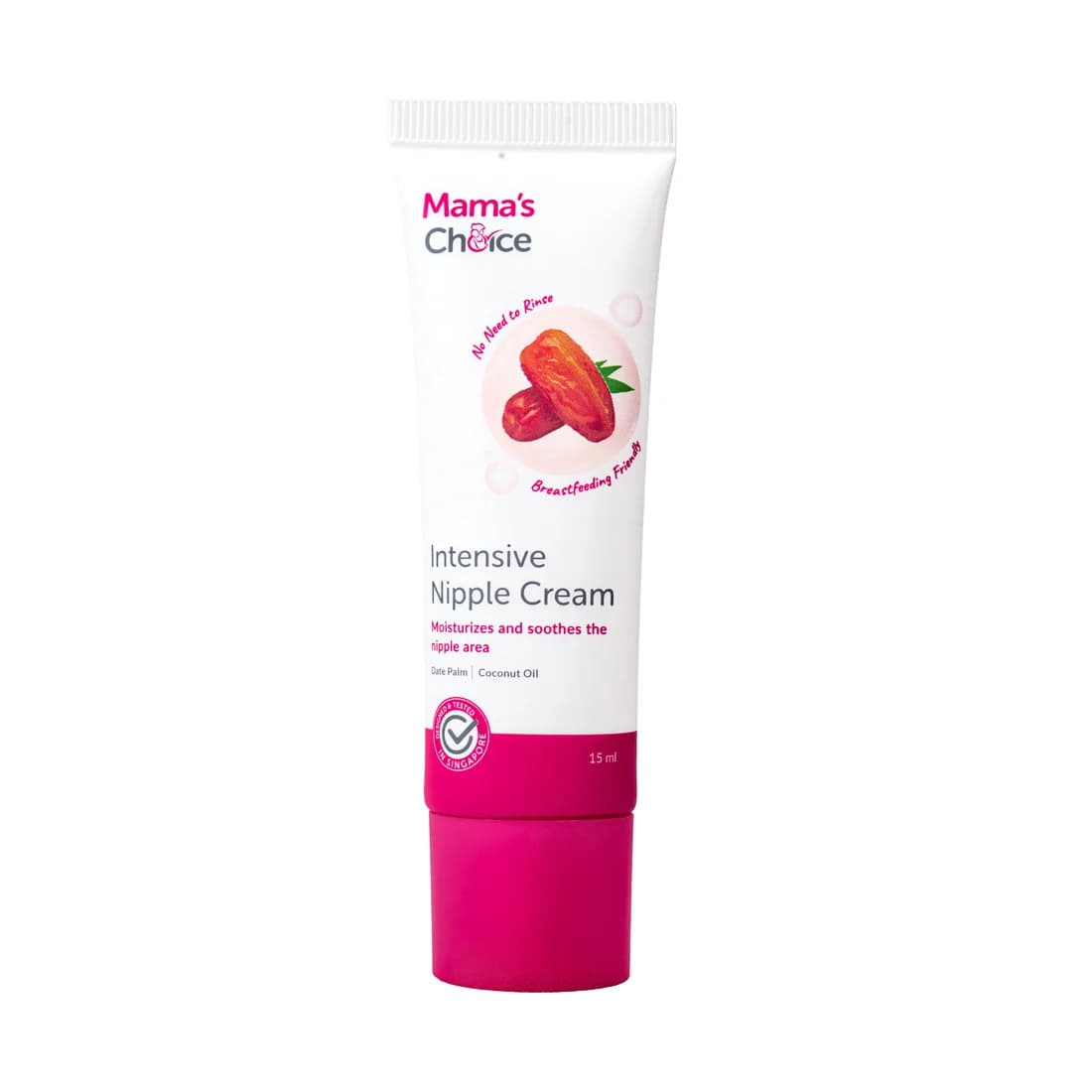
A good balm takes care of the dry side of this. Mama's Choice Intensive Nipple Cream is a rich lanolin balm with shea butter and coconut oil that moisturises and protects nipple and areola skin, so it stays soft through air-conditioned nights and haze weeks alike. Its directions say there is no need to wipe it off before a feed, which saves a step when your baby is already working hard at the latch. Our guide to using nipple cream properly covers how much and how often.
What about engorgement?
Engorgement flattens a nipple that was fine the week before. Milk comes in around day three, the breast firms up, and the areola goes tight.
Feed often. Eight to twelve times in twenty-four hours is the usual newborn pattern, and spacing feeds out to "save up" milk makes the firmness worse. Soften the breast before latching with hand expression or a warm shower.
Reverse pressure softening helps too. Press your fingertips into the areola around the base of the nipple for a slow count of thirty, which moves fluid backwards and lets the nipple stand out.
If a firm lump stays after a feed, read our piece on clearing a clogged milk duct before it turns into mastitis.
Where to get help in Singapore
Nobody fixes a latch by reading about it.
KK Women's and Children's Hospital and the National University Hospital both run lactation services, and both see mothers after discharge rather than only during the stay. Your polyclinic can refer you, and HealthHub, the Ministry of Health's public portal, lists breastfeeding support alongside its antenatal material.
Timing is worth planning. Government-Paid Maternity Leave runs to sixteen weeks under the scheme administered by the Ministry of Manpower, and the first two of those weeks tend to be when latch problems are easiest to correct. Book the appointment early rather than saving it for a crisis.
Confinement nannies are common here and often very experienced, though their advice on latch varies. A nanny who suggests topping up with formula at every feed is making a call that affects your supply, so take that one to a lactation consultant rather than settling it in the kitchen.
When to ask sooner rather than later
- Your baby has not regained birth weight by two weeks
- Fewer than six wet diapers a day after day five
- Nipple pain that continues through the whole feed rather than easing after the first few sucks
- Cracked or bleeding skin, or a white blister that keeps coming back
- A red, hot, painful area with fever, which needs a doctor the same day
- Your baby slides off the breast repeatedly and feeds take over an hour
Pain that persists is information. Most often it means the latch is shallow, which can be fixed. Tongue-tie, thrush and a few other causes are possible too, which is another reason to have someone watch a feed.
For the days when feeding hurts anyway, our guide to breastfeeding pain runs through what helps and when to see a doctor.
Frequently asked questions
- Can I breastfeed if my nipples are flat?
- Usually yes. The American Academy of Pediatrics, through its HealthyChildren guidance, notes that most newborns can latch onto a flat nipple, because a baby draws in a mouthful of breast tissue rather than the nipple alone. What matters more is how deeply your baby is taking the breast.
- What is the difference between a flat and an inverted nipple?
- A flat nipple sits level with the areola and does not protrude, even when stimulated. An inverted nipple pulls inward instead, and often retracts further when you compress the areola behind it. One breast can be flat while the other is not.
- Do breast shells work?
- La Leche League International describes breast shells as something that may help draw out a flat or inverted nipple, worn for a short stretch before a feed rather than all day. They are a positioning aid, so they do not change the shape of the nipple permanently.
- Where can I get lactation help in Singapore?
- KK Women's and Children's Hospital and the National University Hospital both run lactation services, and the polyclinics can refer you. HealthHub, the Ministry of Health's public health portal, lists breastfeeding support services alongside its antenatal content.
- Does engorgement make flat nipples worse?
- It can. A very full, firm breast flattens the nipple and the areola together, which leaves your baby less to grip. Softening the breast first with hand expression or a short pump usually brings the nipple forward enough to latch.
Sources
- American Academy of Pediatrics (HealthyChildren) — breastfeeding and latch guidance
- La Leche League International — flat and inverted nipples
- World Health Organization — infant and young child feeding recommendations
- Ministry of Manpower — Government-Paid Maternity Leave
- HealthHub (Ministry of Health Singapore) — breastfeeding and antenatal support
- KK Women's and Children's Hospital — lactation services
Share this article
This article is for information only and is not a substitute for diagnosis or medical advice. Please talk to your doctor about your own situation.