
What Are the Signs Your Baby Has Colic?
How to tell colic from ordinary crying, what the NHS and AAP say helps, why the heat makes evenings worse, and the symptoms that mean see a doctor.
Colic is prolonged, hard-to-soothe crying in an otherwise healthy, well-fed baby, usually peaking in the late afternoon and evening. It starts in the first weeks and settles by about 4 months. Nothing you did caused it. Holding, movement, winding and a quiet room help more than anything sold in a bottle.
What is colic?
A description, rather than a diagnosis of anything wrong.
The rule of threes is the shorthand both the NHS and the American Academy of Pediatrics use: crying for more than 3 hours a day, on more than 3 days a week, for more than 3 weeks. The baby is growing, feeding and developing normally. There is no fever and no illness to find.
Timing is characteristic. It typically begins at a couple of weeks old, worsens to a peak around 6 to 8 weeks, and fades by 3 to 4 months. For a minority it lasts to about 6 months.
What are the signs your baby has colic?
- Crying that starts for no reason you can identify, often after a feed and a clean diaper.
- Episodes at the same time each day, usually late afternoon or evening.
- A different sound from the usual cry, higher and more piercing.
- Clenched fists, knees drawn up, an arched back, a red face.
- A tense or bloated-looking tummy.
- Inconsolable. The things that normally work do not.
- Settles as suddenly as it started, sometimes after passing wind or a stool.
What should not be there: fever, vomiting that is forceful or green, blood in the stool, poor weight gain, or a baby who has gone floppy and quiet. Those point elsewhere, and the last section covers them.

What causes it?
Nobody knows, and that is the state of the evidence rather than a gap in our research.
The theories with some support behind them: an immature gut and nervous system still learning to regulate; swallowed air and difficulty passing wind; sensitivity to cow's milk protein in a small number of babies; and simple overstimulation at the end of a long day. The AAP treats colic as a normal extreme of infant crying rather than as a disease.
What has not held up is the idea that anxious parenting causes it. Colic appears in calm households and in chaotic ones, in breastfed and formula-fed babies alike.
How do you soothe a colicky baby?
Work through the list and keep what helps your baby. Give each one a few minutes rather than a few seconds.
- Hold the baby upright against your chest, skin to skin if you can.
- Try the forearm hold, baby face down along your arm with your hand supporting the chin.
- Wind thoroughly after every feed, and halfway through as well. Our guide to relieving baby gas has the positions.
- Swaddle, if your baby takes to it, and follow the safe-sleep rules. See what swaddling does.
- Movement. Rocking, a sling, a walk around the block once the heat drops, a stroller ride.
- White noise or a fan. Shushing close to the ear works for many newborns.
- Dim the lights and cut the noise. A quiet bedroom beats a living room with the television on.
- A warm bath, then straight into a cool room.
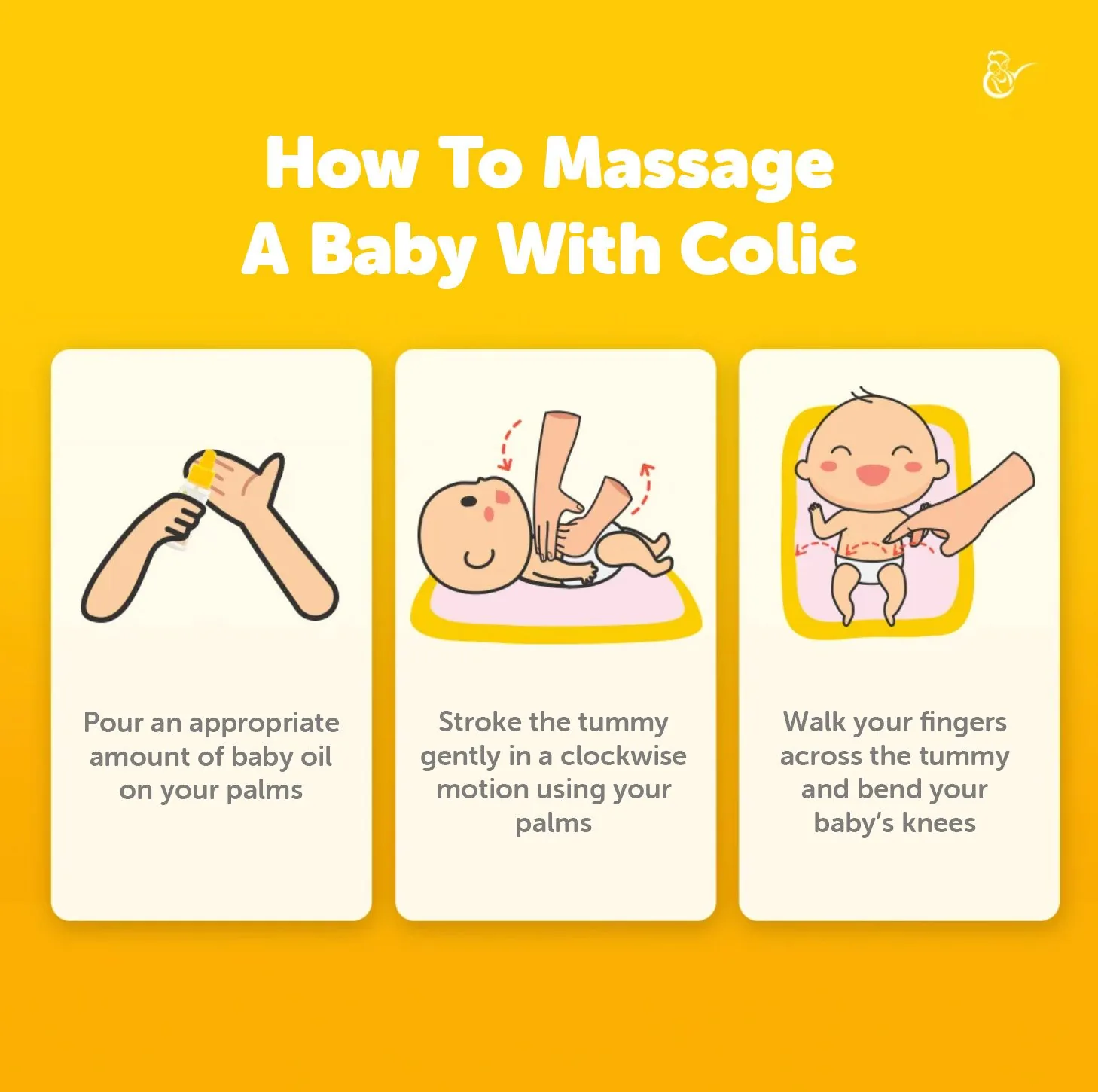
- A gentle tummy massage with your palm, clockwise, with the legs bent up afterwards to help wind move.
- A dummy, if you are past the first weeks and feeding is established.
For massage, plain contact is the active ingredient. No oil is required; if you use one, pick something plain and fragrance-free and keep it off the face and hands.
Does anything in a bottle help?
Not much, and it is worth knowing before you spend money.
Gripe water and simethicone drops are widely used and the NHS notes there is little evidence they work. They are unlikely to do harm from a reputable source, and they are not the answer most packaging implies.
Probiotics have been studied, mostly particular strains of Lactobacillus. A Cochrane review of probiotics for infantile colic found the evidence uncertain, with some trials suggesting benefit in breastfed babies and others showing none. Worth a conversation with your paediatrician rather than a purchase on a recommendation.
Traditional gripe waters and herbal drops bought informally are a different matter. The Health Sciences Authority has repeatedly found unregistered health products in Singapore containing undeclared ingredients, and a newborn is the worst possible person to test one on.
Changing formula or cutting dairy from your own diet should happen on medical advice, not on a hunch. Our bottle feeding guide covers teat flow and feeding position, both of which reduce swallowed air.
Does the heat make it worse?
It can, and this is the part most colic advice written elsewhere leaves out.
An overheated baby cries, and the symptoms overlap with colic: red face, fussing, inconsolable. Before you assume colic in the late afternoon, check the back of the neck. If it is sweaty, strip a layer.
Practical adjustments for Singapore:
- Dress a newborn in one thin layer, not the cardigan grandmother brought.
- Use the air-conditioning or a fan on a low setting, pointed at the wall rather than the baby.
- Shift the evening walk to after 7pm when the pavements have cooled.
- Watch for heat rash on the neck and trunk, which is itchy and makes fussing worse.
- Keep the swaddle thin, muslin rather than fleece, if you swaddle at all.
How do you get through the evenings?
This is a survival question more than a medical one.
Take shifts. If you have a confinement nanny, the evening peak is exactly when to use her. If your partner is home by 7pm, hand the baby over at the door. Twenty minutes in another room with the door shut is a legitimate intervention.
When you are on your own and at the end of it, put the baby down in the cot, walk out, and breathe. A crying baby in a safe cot is fine for five minutes. Never shake a baby; the AAP is unambiguous that shaking causes severe and permanent brain injury, and it most often happens when a carer has reached exactly this point.
Tell someone how bad it is. A polyclinic doctor, your own GP, a friend who has been through it. Persistent low mood, hopelessness or intrusive thoughts after birth need help, and KKH and NUH both run mental health services for mothers. Our guide to surviving sleep deprivation and baby sleep covers the nights.
When should you see a doctor?
Get seen the same day if your baby has a fever, is vomiting forcefully or bringing up green fluid, has blood or mucus in the stool, has fewer wet diapers than usual, or has become floppy, pale or unusually quiet. A baby under 3 months with a temperature of 38°C or higher needs a doctor straight away, not later in the day.
Also go if the crying started suddenly after a settled period, if there is a swelling in the groin, or if your baby is not gaining weight. KKH runs a children's emergency department, and polyclinics handle everything less urgent.
And go simply because you need someone to check. A doctor confirming that nothing is wrong is worth the trip in week six, even when the answer is that you have a normal baby with a loud evening.
Frequently asked questions
- What counts as colic?
- The working definition both the NHS and the American Academy of Pediatrics use is the rule of threes: crying for more than 3 hours a day, on more than 3 days a week, for more than 3 weeks, in a baby who is otherwise healthy and feeding and growing well. The crying is hard to soothe and often worst in the evening.
- When does colic stop?
- It usually peaks at around 6 to 8 weeks and settles by 3 to 4 months. A small number of babies carry on to about 6 months. Knowing it has an end point is one of the few genuinely useful things anyone can tell you in week five.
- Does gripe water or simethicone work?
- The evidence is weak. The NHS notes there is little proof that these products help, though many parents try them. Traditional gripe waters sold informally are worth avoiding altogether, as the Health Sciences Authority has repeatedly found undeclared ingredients in unregistered products.
- Could it be a milk allergy?
- Occasionally. Cow's milk protein allergy can present as inconsolable crying, and it usually comes with other signs: blood or mucus in the stool, vomiting, eczema, poor weight gain. Do not change formula or cut dairy from your own diet without talking to a doctor first.
- What do I do when I cannot cope with the crying?
- Put the baby down safely in the cot, leave the room, and take a few minutes. Never shake a baby; the AAP is explicit that shaking causes serious brain injury. Call someone, swap with your partner or your confinement nanny, and tell your doctor how bad it is getting.
Sources
- NHS — Colic in babies
- American Academy of Pediatrics, HealthyChildren — colic and crying in infants
- Cochrane — Probiotics for infantile colic
- Health Sciences Authority Singapore — risks of unregistered health products
- KK Women's and Children's Hospital — children's emergency and lactation services
- HealthHub, Health Promotion Board — newborn care and crying
Share this article
This article is for information only and is not a substitute for diagnosis or medical advice. Please talk to your doctor about your own situation.